The final round of matches in FIFA World Cup Group E brings together two nations with very different immediate objectives but an equally strong desire to make a statement when Ecuador take on Germany at MetLife Stadium in East Rutherford, New Jersey, on Thursday, 25 June 2026. Kick-off is scheduled for 9pm BST, with the contest forming part of a decisive evening in the race for places in the knockout phase of the tournament.
As the group stage approaches its conclusion, the significance of this encounter is impossible to ignore. Germany arrive having already secured progression after opening the competition with successive victories, while Ecuador know that only a major result against one of international football’s most decorated sides can keep their hopes alive. With qualification scenarios still being resolved and momentum increasingly valuable at this stage of the World Cup, both teams have compelling reasons to approach the match with maximum intensity.
For Ecuador, the occasion represents both a challenge and an opportunity. Sebastián Beccacece’s side entered the tournament carrying considerable confidence after an impressive qualifying campaign and a lengthy unbeaten run in international competition. Expectations were understandably elevated as a result, yet the opening two group matches have left La Tri with work to do. A narrow 1-0 defeat against Ivory Coast in their first outing was followed by a frustrating goalless draw against Curaçao, leaving the South Americans under pressure heading into their toughest fixture of the group.
Despite those results, the performances themselves have offered encouragement. Ecuador dominated large portions of the match against Ivory Coast and were unfortunate not to emerge with at least a point before conceding a late winner. Against Curaçao, they controlled possession, created numerous opportunities and repeatedly tested the opposition goal, only to be denied by resilient defending and outstanding goalkeeping. The inability to convert chances has become the central talking point surrounding the team, but the underlying performances suggest a side still capable of troubling elite opponents.
Much of Ecuador’s confidence stems from a squad that blends experience with athleticism and technical quality. Captain Enner Valencia remains an influential figure and continues to provide leadership at the highest level. Midfielder Moisés Caicedo is widely regarded as one of the team’s most important players, offering energy, ball-winning ability and distribution from central areas. Alan Franco has also been a significant presence in midfield, while the defensive unit has generally remained organised despite the disappointing results recorded so far in the tournament.
Beccacece has developed a reputation for demanding intensity without sacrificing structure. His teams are typically aggressive when pressing, committed in transition and willing to commit numbers forward when opportunities arise. That approach has often enabled Ecuador to compete effectively against technically gifted opponents. The challenge against Germany will be finding the right balance between ambition and caution. A passive display is unlikely to produce the result required, yet excessive risk against a side of Germany’s quality could prove costly.
One positive for Ecuador is the absence of major confirmed injury concerns within the squad ahead of the match. The coaching staff have been able to prepare with a largely available group of players, allowing continuity in selection and tactical planning. Equally, there are no confirmed suspension issues affecting the team for this fixture, providing Beccacece with the broadest possible range of options as he prepares for a defining evening in Group E.
Standing across from them will be a Germany side that has quickly established itself as one of the most convincing teams in the competition. Julian Nagelsmann’s men have won both of their group matches and secured qualification with a game to spare, extending an impressive winning sequence in the process. Confidence is high, performances have generally been convincing and the four-time world champions are beginning to attract attention as serious contenders for the latter stages of the tournament.
The campaign began with an emphatic victory over Curaçao, a result that immediately demonstrated Germany’s attacking depth and ruthless efficiency. A more demanding examination followed against Ivory Coast, yet they once again found a way to prevail, securing a 2-1 victory that guaranteed first place in the group. The ability to win in different circumstances has been one of the most encouraging aspects of Germany’s recent form. Whether dominating possession or responding to adversity, they have consistently found solutions.
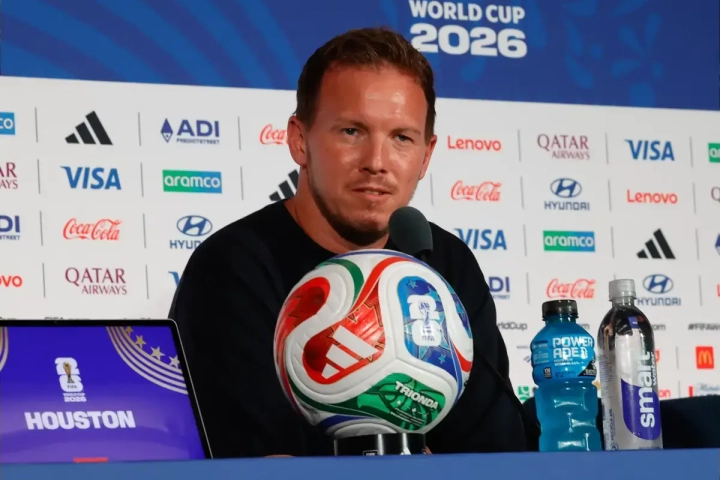
Nagelsmann’s influence continues to be evident. Since taking charge, he has sought to blend tactical flexibility with attacking ambition, encouraging his players to play proactive football while maintaining defensive organisation. The result has been a team capable of controlling matches through possession but equally comfortable exploiting space when opponents commit players forward.
Several individuals have contributed significantly to Germany’s strong position. Deniz Undav played an important role in the victory over Ivory Coast, while Nadiem Amiri made a notable impact from the bench and provided a key assist. The squad contains quality across every area of the pitch, allowing Nagelsmann to rotate when necessary without significantly weakening the overall level of performance.
Defensively, Germany have received an unwelcome setback. Centre-back Nico Schlotterbeck suffered a serious ankle injury during the victory over Ivory Coast and has been ruled out for the remainder of the tournament. His absence removes an important option from the back line and forces a reshuffle in central defence. Antonio Rüdiger, one of the most experienced figures in the squad, is expected to assume greater responsibility alongside Jonathan Tah as Germany seek to maintain their defensive solidity.
Aside from Schlotterbeck’s confirmed absence, Germany do not have any publicly confirmed suspension concerns ahead of the fixture. That leaves Nagelsmann with a strong squad from which to choose as he balances the desire to preserve momentum with the demands of managing players through a long tournament.
The tactical battle promises to be one of the most intriguing elements of the contest. Ecuador’s pressing game and willingness to attack could create an open encounter, particularly given their need for a positive result. Germany, however, are exceptionally dangerous when opponents leave space between the lines. Their movement in attacking areas, combined with their ability to progress the ball quickly through midfield, means any loss of concentration can be punished immediately.
Midfield control may ultimately determine the rhythm of the game. Ecuador will look to disrupt Germany’s passing sequences and create turnovers in advanced positions, while Germany will attempt to use possession to stretch the South American side and force defensive decisions. The duel between the central midfield units could have a significant influence on both territory and tempo.
There is also a psychological dimension to the occasion. Germany have already achieved their primary objective of qualification, but maintaining momentum before the knockout rounds remains important. Successful tournament teams often build confidence through consistent results, and Nagelsmann has made clear that intensity levels cannot drop simply because progression has already been secured. Ecuador, meanwhile, are playing with urgency and know that their World Cup future hangs in the balance.
Historical context adds another layer of intrigue. Meetings between the nations have been rare, but Germany have won both previous encounters. Their first came at the 2006 World Cup, where Germany recorded a 3-0 victory during the group stage on home soil. The teams met again in a friendly in 2013, with Germany emerging victorious by a 4-2 scoreline. While those results have little direct bearing on the present, they contribute to a broader narrative surrounding a fixture that has seldom appeared on the international calendar.
The contrast between the footballing traditions of the two countries is also notable. Germany remain one of the most successful national teams in history, with multiple World Cup titles and decades of sustained excellence. Ecuador’s rise has been more recent, but the nation has established itself as a consistent force in South American football and continues to produce players capable of competing at the highest level. Their presence on this stage is evidence of the progress made over the past two decades.
Beyond the immediate qualification implications, the match forms part of a wider story unfolding across the tournament. Germany are attempting to build on recent progress and reassert themselves among the sport’s elite after mixed fortunes in previous major competitions. Ecuador are seeking another landmark achievement on the world stage and an opportunity to demonstrate that they belong among international football’s leading nations.
Attention will naturally focus on key individual contests. The experience and movement of Valencia against Germany’s reshaped defence could be influential, while the battle for midfield authority promises to feature players capable of dictating the direction of the game. Set pieces may also assume greater importance than usual given the pressure and fine margins that often define decisive group-stage encounters.
As kick-off approaches in East Rutherford, the stakes ensure an atmosphere rich with anticipation. One team enters the match with qualification already secured but determined to continue a remarkable run of results. The other arrives knowing that its tournament future depends on producing its finest performance yet. Those circumstances create the conditions for a compelling contest between two sides with contrasting positions but shared ambition.
World Cups are often remembered for nights when pressure, opportunity and quality collide in memorable fashion. Whether Germany continue their momentum or Ecuador produce the result they desperately require, Group E’s concluding chapter has all the ingredients of a significant occasion. With progression, pride and momentum all on the line, MetLife Stadium is set to provide the stage for a match carrying importance far beyond the final whistle.