
[directorist_search_result]

New Mural Unveiled at Jesus Green Lido

A new mural celebrating Cambridge’s long-standing ties to water, community, and recreation has been unveiled at Jesus Green Lido.

Titled The Human Current, the artwork covers 120 square metres of wall, fence, and rotundas, and is thought to be the largest mural in the city. Created by London-based artist Anugrah Mishra, the piece portrays swimming, movement, and the connection between residents and the river, reflecting both energy and local heritage.

The project was initiated by Jesus Green Lido assistant manager Annabel Wright as a creative response to persistent graffiti. She identified Mishra, who began his artistic career at Anglia Ruskin University, and worked with Cambridge City Council to secure commissioning support.

Annabel Wright said: “The path next to the Lido is always busy and, over time, the walls had become a favourite spot for graffiti. We thought: why not turn it into a space for art that everyone can enjoy? We reached out to Anugrah in June and shared his designs with the council, who loved the idea and generously provided the funding to make it a reality.”

Cllr Antoinette Nestor, Cabinet Member for Culture, Economy and Skills at Cambridge City Council, added: “Anugrah’s mural has really given a massive lift to this stretch of the river, which is enjoyed by so many walkers, cyclists and boaters every day. Its vibrancy and colour emphasise the role that water plays in making Cambridge the unique place it is – both for those who swim regularly in the city’s pools, and for residents and visitors who enjoy the proximity to our river and waterways as part of their daily life. It was great that we were able to use S106 funding from developers for public art to make this project come to life in a truly collaborative way – as part of a wider art programme involving local young people, called Urban Voices. My thanks and congratulations go out to everyone involved.”

Work began on 1 September and concluded in late November.

Anugrah Mishra said: “Collaborating with Cambridge City Council and GLL on The Human Current has been deeply meaningful, as Cambridge is where my artistic journey first began. I wanted the mural to capture the joy and energy of swimming while reflecting the city’s heritage through flowing figures, water symbolism, and historical references. By blending these elements with the Lido’s own colours, my aim was to create a landmark that connects people to both their community and the long-standing tradition of water in Cambridge life.”

Mishra, who won the Freelands Painting Prize in 2024, is recognised for blending classical artistic influences with symbolic storytelling. His work frequently explores themes of memory, human vulnerability, and resilience. He has exhibited widely across the UK, with features in publications such as Aatanou Magazine and the Freelands Foundation catalogue.

Before focusing on large-scale public art, Mishra worked within established institutions including The Heong Gallery and the Fitzwilliam Museum. His academic training at Anglia Ruskin University laid the foundation for a practice that seeks to make painting accessible beyond traditional gallery spaces, with a particular emphasis on community engagement.

The Lido is operated by GLL, a charitable social enterprise partnering with the council to enhance physical, mental, and social wellbeing.

This summer, swim visits to Jesus Green Lido between June and August reached 61,232, up from 41,880 the previous year – a 46.2% increase. Rising UK temperatures contributed to the busiest summer in the Lido’s history. GLL notes this reflects a growing national interest in outdoor swimming, recognised for its health benefits, with 200,000 people participating in their swim lessons each week.


St Benets and Roman Caistor take centre stage in new Norfolk history charity drive

The Norfolk Archaeological Trust has extended its Support Your Site scheme to two of its best known historic locations, St Benet’s Abbey and Caistor Roman Town. The launch follows the introduction of the initiative earlier this month at Tasburgh Enclosure.

The Support Your Site Norfolk Archaeological Trust scheme encourages individuals, families and organisations to contribute through a small monthly donation. Money raised is directed towards ongoing site care, conservation work, community engagement and improvements to the visitor experience, helping to keep sites accessible and well maintained.

Natalie Butler, Director of the Norfolk Archaeological Trust, said: “St Benet’s Abbey and Caistor Roman Town are extraordinary places where thousands of years of history remain woven into the Norfolk landscape. This new scheme is about giving people a simple, meaningful way to help look after the sites they love. Every contribution – big or small – makes a real difference in ensuring these places remain free to access and well cared-for for future generations.”

Caistor Roman Town, also known as Venta Icenorum, was the largest Roman town in East Anglia. Established in the AD70s, it began as an unenclosed settlement before banks and walls were added in the 3rd century AD. The remains reveal a planned grid of streets, with evidence of an amphitheatre to the south and a temple to the north-east, alongside others in the town centre.

The town once had running water, baths, a basilica and a forum. Although occupied into the early 6th century during the Anglo-Saxon period, its Roman structures gradually fell into disrepair. The settlement was abandoned in the 8th century as Norwich emerged as the county’s civic centre. Today, Caistor Roman Town is one of only three Roman towns in England not built over in later centuries, making it a rare site for archaeological study.

St Benet’s Abbey lies within the Broads near the confluence of the rivers Bure and Ant. Founded in the Anglo-Saxon period, it was the only monastery in Norfolk to remain in use throughout the Middle Ages. It is also unique in England for not being closed by Henry VIII, with the Bishop of Norwich continuing to hold the title of Abbot.

The abbey has long been recognised for its atmosphere as well as its history. For more than two centuries it has attracted artists, photographers and visitors drawn to its distinctive setting and remains.

Supporters of the Support Your Site Norfolk Archaeological Trust scheme receive a range of benefits. These include a biannual newsletter, invitations to the NAT Summer Social and the annual Director’s Walk and Talk, and recognition on the Trust’s website. After two years of continuous support, supporters may also be eligible for an on site plaque.

The scheme can also be given as a gift, offering a locally focused present for birthdays, Christmas or other occasions.

“Our supporters play a vital role in safeguarding Norfolk’s heritage,” Natalie added. “We’re excited to offer a new way for people to deepen their connection with these remarkable landscapes and help us protect them for years to come.” d

University of Suffolk Architecture Course Earns RIBA Validation in Major Industry Milestone

The University of Suffolk’s Architecture course has reached a defining moment. After a rigorous two-day assessment, the BA (Hons) Architecture programme has been awarded full validation by the Royal Institute of British Architects (RIBA), placing it firmly on the national and international map.

RIBA, the global professional body for architects, visited the University in early December to put the course through its paces. The review was comprehensive: student portfolios and transcripts were scrutinised, teaching standards and facilities assessed, and in-depth discussions held with staff, students, senior management and external examiners. A full exhibition of student work spanning all three years of study formed part of the evaluation.

The outcome was clear. RIBA validation was granted, formally recognising the course as a strong foundation for professional architectural practice.

The achievement marks the culmination of a journey that began in 2021, when the programme secured RIBA candidate status and entered a period of close monitoring against the institute’s benchmarks. Full validation now means graduates will be eligible to progress to RIBA Part 2 postgraduate architecture courses around the world.

Crucially, the course already holds Part 1 prescription from the Architects Registration Board (ARB), the UK’s statutory regulator for architects. With accreditation from both RIBA and ARB, the University of Suffolk’s architecture programme now carries the industry’s two most important stamps of approval.

For Course Leader and Senior Lecturer Aishani Jayasinghe, the validation represents both recognition and reassurance.

“Securing RIBA validation for the first time is a very significant milestone for our course and demonstrates the high standard of teaching our students enjoy,” she said.

“RIBA recognition is incredibly important for architecture courses across the country, and having this will mean our future applicants and their families can be sure that they will have an exceptional experience in our fantastic facilities and with support from dedicated teachers with years of industry experience.”

The course’s strengths lie not only in accreditation, but in how students learn. Throughout their studies, undergraduates work on real-world sites across Suffolk, developing proposals for locations such as Orford Ness, the former Sanyo factory in Lowestoft, Cliff House in Felixstowe, and several sites in Ipswich including Fore Street and the old Crown Court.

Their education is also shaped beyond the county. Field trips to cities including Rome, Rotterdam and Copenhagen expose students to some of Europe’s most influential architectural thinking, while visits across East Anglia ground their work in regional context.

Earlier this term, the public was invited to see the results. A free exhibition, Architecture – Volume Zero, showcased student projects in the University’s Waterfront Building, offering a snapshot of a course now firmly validated by the profession it serves.

Suffolk Police Winter of Action Ensures Safe Festive Season

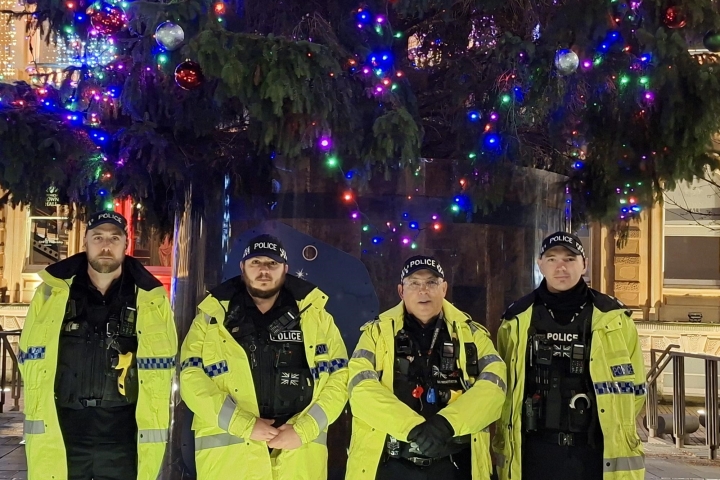
Suffolk Police is continuing to step up its presence this festive season with a series of high-visibility patrols and community engagement initiatives as part of the national Winter of Action campaign.

The operation has been designed to address the seasonal pressures that come with Christmas and New Year, including busier town centres, festive events, increased socialising, and risks linked to retail crime, night-time economy issues, and violence against women and girls.

Officers will focus on key town centre hotspots, providing reassurance, deterring offenders, and supporting victims. Targeted deployments will see police visible in areas such as transport hubs, shopping streets, and outside bars, pubs, and nightclubs. Officers will also attend late-night shopping venues, Christmas light switch-ons, and other high-footfall festive events.

A key component of the initiative is Project Vigilant, which deploys uniformed and plain-clothed officers to identify and deter predatory behaviour in night-time economy locations. Officers will monitor for signs of sexual harassment, inappropriate touching, and loitering, aiming to proactively prevent violence and sexual offences while ensuring everyone can enjoy their night out safely.

Community engagement is central to the campaign. Officers will speak with shoppers, socialisers, and bar-goers, offering advice and reassurance. They will also collaborate with licensed premises, town pastors, and other partner agencies to tackle crime and anti-social behaviour.

Chief Inspector Matt Breeze emphasised the importance of the initiative: “We want people to enjoy the build up to Christmas and New Year in a safe environment and people should feel reassured we will have officers and staff on duty at those times and in those places where we anticipate our highest demand.”

He added that overlaps of shifts on peak nights will ensure a strong presence in night-time economy locations, continuing into the early hours to address vulnerability and potential risks. Breeze highlighted proactive work in retail areas, including high-visibility and covert patrols to combat shoplifting, protect staff, and disrupt persistent offenders.

The policing activity will continue beyond the Christmas period, with January sales expected to see increased footfall. Preventative powers under the Anti-Social Behaviour Act, along with Community Protection Notices and Criminal Behaviour Orders, will be used where necessary. Design Out Crime Officers will provide advice to local businesses on reducing theft and burglary.

Police and Crime Commissioner Tim Passmore welcomed the initiative, saying: “It is really important that everyone feels safe when enjoying a night out so I welcome the multi-agency Winter of Action campaign which focuses on the issues which undermine those feelings of safety. I fully support the Constabulary’s additional focus on tackling retail crime and persistent anti-social behaviour, and offending linked to the night-time economy and violence against women and girls.

“We are determined to maintain Suffolk’s reputation as one of the safest counties in the country and I thank everyone who will be working over these busier, festive months to keep people safe. This Winter of Action sends a clear message that our town centres are safe and welcoming places. I want residents, visitors and businesses to feel confident that we are taking action to protect them, not just during the festive season but all year round.”

East Anglia Christmas Eve Travel Advice Amid Record Festive Trips

Travellers across East Anglia are being urged to plan ahead this Christmas Eve as record levels of festive travel are expected.

The RAC forecasts 37.5 million trips across the UK in the week leading up to 25th December, the highest number since it began collecting data in 2013. With Christmas falling mid-week, drivers are setting off early, with 6.5 million journeys expected on Wednesday 17th and Thursday 18th December. Christmas Eve itself is likely to see 4.2 million trips nationwide, making it the busiest single day of the festive getaway.

For East Anglia, this means busy roads across Norfolk, Suffolk, Cambridgeshire, and Essex. Main routes into Norwich, Ipswich, Cambridge, and Colchester are expected to be heavily congested. Drivers should allow extra travel time, check weather forecasts, and be prepared for slower journeys in rural areas where icy or frosty conditions may occur.

Public transport users are also advised to pay close attention to service updates. Greater Anglia has issued travel advice for Christmas and New Year, highlighting major changes and closures. London Liverpool Street station will be closed from 25 December to 1 January for roof replacement and essential maintenance within the Bishopsgate tunnel. During this period, many services to and from London will start or terminate at Stratford, with ticket acceptance arranged on the Elizabeth Line, Central Line, Victoria Line, and Circle, Hammersmith & City, and Metropolitan Lines for journeys connecting with London Liverpool Street.

Christmas Eve will see an early shutdown for trains, with most services ending by 22:00 and reductions starting from 19:00. The Stansted Express will operate as an exception, with the last service to Stansted Airport departing London Liverpool Street at 23:21 and the last return at 22:43. No services will run on Christmas Day, and only a limited Stansted Express will operate on Boxing Day. Services from 27 December to 4 January will run on a revised schedule, with buses replacing trains between Stansted Airport and Cambridge North and between Bury St Edmunds and Cambridge.

Martin Beable, Managing Director of Greater Anglia, said: “While most of our services will be running over the festive period, so that people can continue to travel across East Anglia and beyond, engineering work is taking place and will affect passengers travelling on both main lines to and from London and in the Cambridge area. Since the railway tends to be much quieter over this period, Network Rail uses it to carry out essential upgrade work that will help Greater Anglia to continue operating a very punctual and reliable service for customers in 2026. We apologise for the inconvenience caused by the service alterations, and we urge passengers to check before they travel as some journeys may take longer than normal.”

Travellers are advised to use Greater Anglia’s journey planner on the website or app to confirm times and plan connections. By preparing in advance, whether driving or taking the train, visitors and residents can make their East Anglia Christmas Eve journey safer, smoother, and less stressful.

Taking away doctor’s ability to strike is compelling their surrender

“Why should Hospital Doctors be allowed to strike?”

This question is doubtless going to be thrown around a few Christmas dinner tables when conversations get more political than needed. “Lives need to be saved, surely that’s more important than pay cheques! Why can’t they just negotiate for better salaries like everyone else?”

A short answer to the question might be “What other option do they have?”. If they cannot negotiate better salaries in the normal way, what other option is there but to strike.

“But why can’t they just negotiate?” This might seem like a reasonable question, but to answer, we need to understand the difference between “negotiation” and “surrender” in a military context.

Negotiation tends to happen when you have at least two entities who are in dispute and each possessing the power to seriously harm one another with force. Exactly who would win is not necessarily certain, but what is certain is that a lot of people will be killed or injured if these forces ever should clash. Not all of them deservedly so. Since no one wants those people to die, the dispute must be resolved by non-violent means.

Surrender happens when one of the multiple entities no longer has any realistic power to harm the other, and as such they have to accept that the dispute will be resolved in the interest of the party that does have power. When one side no longer has any power to threaten the other, or valuable things to offer them in exchange, surrender is all that they can do.

This distinction between negotiation and surrender is why doctors have to be allowed to strike.

If they can no longer strike, they have no means of force by which they can negotiate for their pay.

Pay negotiation for doctors isn’t like pay negotiation anywhere else. It isn’t as if a doctor at a hospital in one city can say that they will be offered more pay/better conditions in another. Pay-scales and benefit programmes across the NHS are fixed, and while there may be some slight gradations between different hospitals, these are based on regional affordability, not negotiated salary packages.

Also, since the issue is persistent since 2008, with pay being 20% lower than what it was then (factoring in inflation) then clearly normal “negotiation” hasn’t got the result that they want or need.

Add to that the fact that resident doctors have to pay for insurance and other professional memberships out of their own pockets. Payments for things that in other professions would be covered by existing bodies.

And even if doctors cannot vote with their feet to other hospitals or practices, they can leave the UK or indeed the profession as a whole. Data published by the British Medical Journal in August 2025 showed that one third of doctors have taken “hard steps” towards ending their practice of medicine in the UK. Some are looking for UK based non-medical roles, while others are looking to practice medicine in other countries, such as New Zealand, Australia, or Canada.

The GMC’s chief executive, Charlie Massey, said, “Like any profession, doctors who are disillusioned with their careers will start looking elsewhere. Doctors need to be satisfied, supported, and see a hopeful future for themselves.”

Taking away the ability of medical staff to use force to demand better pay will hardly make people more willing to stay. It will feel much more like capture and hostage-taking.

Those who demand that doctors loose the legal ability to strike have to answer the question “How will they compel better pay and conditions?”

If one side has its ability to fight back forcibly removed, what you are left with is not negotiation. It is surrender.

Nearly 400 homes lose power after high-voltage fault

Almost 400 properties have been left without electricity after a serious technical fault disrupted power supply.

UK Power Networks confirmed it was alerted to a power cut affecting communities between the market town Mildenhall and the village of Fornham All Saints shortly after 2pm this afternoon.

Initial assessments indicate the interruption was linked to a fault on a high-voltage electricity line.

The company said 390 homes and businesses within the IP28 6 postcode area were still without power. Engineers are continuing to carry out investigations, but given the danger and power levels involved this will take time.

Restoration was expected between 3.30pm and 4.30pm, although UK Power Networks have qualified that statement, and encouraged the public to manage expectations. They cautioned that this timeframe could change depending on what engineers find.

“Forest city” plans are “Rational and considered” claims architect

The “Forest City” plans for west Suffolk have been described as practical and carefully thought through by one of the architects involved.

The proposal would see up to one million people housed in affordable homes on what was formerly farmland just east of the city of Cambridge, between Newmarket and Haverhill.

Businessmen Shiv Malik and Joseph Reeve are the project’s key drivers. Architect Steve McAdam, who sits on the board of directors, was reported to say the location “seems to be a very good place to locate a population growth”.

Mr McAdam has an impressive portfolio, having previously worked on the London King’s Cross redevelopment and the London Olympics and post Olympic masterplans.

The Forest City Suffolk plans would include 400,000 homes across 45,000 acres, alongside 12,000 acres set aside for a new forest. No formal planning application has yet been submitted, and the developers have said it could take several years before detailed blueprints are ready.

The idea has already attracted criticism. Nick Timothy, the Conservative MP for West Suffolk, has previously described the proposal as “ridiculous”. He was approached again for comment.

Mr McAdam said the vision for Forest City emerged from “a very different avenue, a much more disruptive process” than traditional new town developments. Speaking on BBC Radio 4’s Today programme, he said: “It’s not in any local plan, there’s no government agency sponsoring it, it’s not as though a bunch of developers are behind it or volume house builders.”

He pointed to around 1,200 young people who have signed an online petition supporting the Forest City Suffolk plans. “They say they are the generation that is worse off than their parents and they don’t think it should be like that,” he said. Rather than “just moaning”, he added, the team had produced a proposal that was “quite rational and considered”.

Mr McAdam also said the site aligned with two government growth initiatives, the Oxford Cambridge corridor and the innovation corridor. He confirmed discussions were under way with seven landowners, with one already on board and two others expressing interest.

“But the key ingredient here is cost and we want to use a community land trust, external which will keep the values of the land to the trust itself,” he said.

“The reason people can’t afford to buy is not the property value itself, it’s the land it stands on and that can escalate massively, so by controlling that we think we can keep the cost of a four-bedroom house down to £350,000.”

Norwich Debenhams student flats plan set to progress in 2026

The Debenham’s building in Norwich city centre is likely to be redeveloped next year after a prolonged pause, despite widespread protest.

The five storey department store has stood empty since the retailer collapsed in 2021, becoming a prominent vacant site in the city.

Proposals to demolish most of the structure and replace it with student accommodation were first submitted at the start of last year. The scheme would deliver 377 student rooms alongside retail units at ground floor level. Since then, progress has stalled, but developers now expect movement on the Norwich Debenhams student flats plans.

Agents acting for the developers have said they understand a recommendation to grant planning permission will be made in 2026. The proposals, put forward by Orford House Developments Limited, would see most of the existing building knocked down and rebuilt to a height of eight storeys.

The plans have generated opposition. Campaign group Save Britain’s Heritage described the current building as “handsome” and warned that demolition “would cause substantial harm” to the surrounding conservation area. Questions have also been raised about whether the city needs more student accommodation at all.

Green city councillor Martin Schmierer said Norwich already has more than enough student housing properties.

While he is a fan of the building and would be happy to see it brought back into use, he believes it should be repurposed for lower cost housing with communal areas aimed at residents not studying at the university. He also criticised the demolition element of the Norwich Debenhams student flats proposal.

“We are living in an environmental and ecological crisis, and the amount of carbon that that would create and put into our atmosphere is simply unjustifiable,” he said.

Labour councillor Carli Harper, the council’s deputy leader, described the current state of the site as an “eyesore”.

She said she was hopeful of “some activity there soon” and added that Norwich council’s recent decision to limit new student accommodation had already taken the Debenhams scheme into account, meaning it would not be “a breach of that policy”.

A spokesman for the company’s agents, Lanpro, said the application had been delayed by the “challenges of nutrient neutrality”. This government policy is designed to prevent further increases in nutrient levels in rivers, which are already affected by sewage and agricultural run off.

The spokesman said ODHL had been on “a long journey” with the plans and that council officers were expected to recommend approval, allowing the Norwich Debenhams student flats redevelopment to proceed. “[Their] objective has always been to transform a dilapidated, outdated, and obsolete building into a thriving student accommodation hub with vibrant retail units at ground floor level,” he said.

Skip to content Skip to content