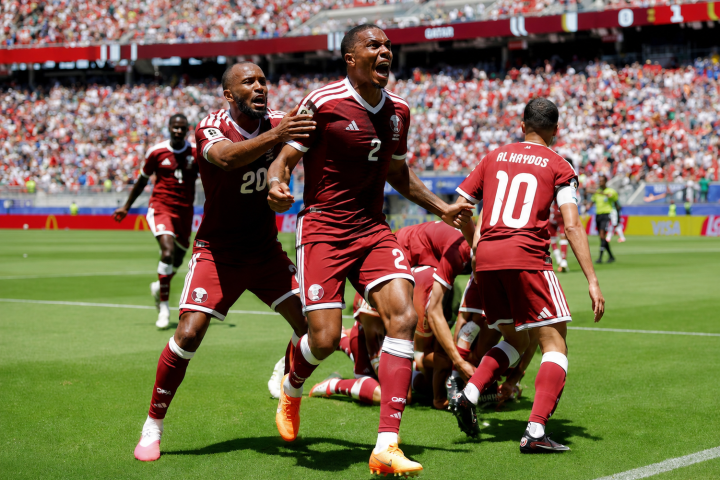
Qatar produced one of the most memorable moments of the early stages of the 2026 FIFA World Cup by battling back to earn a dramatic 1-1 draw against Switzerland in Santa Clara, securing the nation’s first-ever point at a World Cup finals. Just when it appeared the Swiss would leave California with all three points, veteran captain Boualem Khoukhi rose highest deep into stoppage time to head home an equaliser that sparked wild celebrations among players, coaching staff and supporters alike.
The result represented far more than a single point. For a nation that endured a difficult debut World Cup campaign on home soil in 2022, where they lost all three group-stage matches, this draw felt like a significant step forward. It was a performance built on determination, discipline and belief, qualities that carried Qatar through difficult moments against a Swiss side that controlled large portions of the contest and created numerous opportunities to secure victory.
Switzerland entered the match as favourites. Their recent tournament pedigree, experienced squad and strong qualifying campaign made them one of the more dangerous teams outside the traditional elite. Led by the influential Granit Xhaka in midfield and boasting attacking talent throughout the squad, the Swiss were expected to begin their campaign with a win.
The opening stages suggested those predictions might prove accurate. Switzerland quickly established control of possession and forced Qatar into a compact defensive shape. The Swiss circulated the ball confidently across midfield, probing for openings while Qatar concentrated on maintaining organisation and limiting space in dangerous areas.
Despite Switzerland’s territorial dominance, Qatar initially coped reasonably well. Their defensive line remained disciplined, and goalkeeper Mahmoud Abunada looked composed when called into action. However, as the pressure increased, cracks eventually began to appear.
The game’s first major talking point arrived in the 17th minute. Switzerland launched another attack into the penalty area, and Remo Freuler burst through the defensive line before colliding with Abunada. Following a lengthy review, the referee awarded a penalty. The decision immediately generated debate inside the stadium and among viewers, with questions raised about whether there may have been an offside in the build-up.
After the review process was completed, the penalty stood. Breel Embolo stepped forward and calmly converted, sending Abunada the wrong way to give Switzerland a deserved 1-0 lead. The goal rewarded Switzerland’s strong start and appeared to put them firmly in control of the contest.
For Qatar, the setback could easily have triggered memories of previous disappointments. Instead, they responded positively. Although they struggled to create sustained attacking pressure, they refused to panic and remained committed to their tactical plan.
Switzerland continued to dominate possession throughout the remainder of the first half. Xhaka dictated the tempo from midfield, while Embolo and his fellow attackers repeatedly found pockets of space around the edge of the penalty area. Several opportunities came and went as the Swiss looked to double their advantage.
Abunada, despite being involved in the incident that led to the penalty, recovered well and produced a number of important interventions. His saves kept Qatar within touching distance and ensured the match remained alive heading into the second half.
The statistics at the break painted a clear picture. Switzerland had enjoyed the majority of possession, created more chances and appeared the superior side in almost every department. Yet their failure to add a second goal left the door open.
That missed opportunity would ultimately come back to haunt them.
The second half followed a similar pattern. Switzerland controlled possession and patiently searched for openings, while Qatar focused on remaining compact and looking for moments to counterattack. The Swiss repeatedly moved into dangerous positions but lacked the clinical finishing required to put the game beyond doubt.
Several opportunities should have increased their lead. Long-range efforts flashed wide, headers drifted off target and promising attacks broke down at critical moments. The longer the score remained 1-0, the more belief began to grow within the Qatar side.
Julen Lopetegui, taking charge of Qatar in his first World Cup match as national team coach, urged his players forward from the touchline. While the tactical discipline remained, there was a noticeable increase in ambition as the game entered its final stages.
Substitutions injected fresh energy into the Qatari side. Midfielders pushed higher up the pitch, while the wide players began delivering more crosses into dangerous areas. Switzerland still looked the more likely team to score, but the momentum was beginning to shift.
As the match entered the closing ten minutes, Switzerland missed another golden opportunity to secure victory. A swift attacking move created space inside the penalty area, but the finishing touch once again failed to arrive. Those missed chances were becoming increasingly costly.
The atmosphere inside Levi’s Stadium intensified with every passing minute. Swiss supporters sensed their team was edging towards an important victory, while Qatar’s fans continued to encourage their side despite the deficit.
Four minutes of added time were indicated, and Switzerland appeared on course to survive the late pressure. Yet football has a habit of producing unforgettable moments when they are least expected.
Deep into stoppage time, Qatar launched one final attack. Homam Ahmed received possession on the left and delivered an inviting cross into the penalty area. As defenders retreated and attackers charged forward, Khoukhi timed his run perfectly.
The veteran captain rose above his marker and connected with a powerful header. The ball took a slight deflection before flying beyond the helpless goalkeeper and into the net.
For a split second there was silence as players and supporters tried to process what had happened. Then came an explosion of noise.
The stadium erupted.
Qatari players sprinted towards the corner flag in celebration. Coaches ran from the bench. Supporters waved flags and embraced one another. It was a moment that instantly became one of the defining images of Qatar’s football history.
The goal not only rescued a point but also secured the nation’s first-ever World Cup point. Considering the struggles of 2022, it represented a remarkable emotional milestone.
There was little time remaining after the restart. Switzerland attempted one final attack, but Qatar held firm. When the referee blew for full time, the contrast in emotions was obvious.
Qatar celebrated as though they had won the match.
Switzerland looked stunned.
From the Swiss perspective, frustration dominated the post-match discussion. They had created enough opportunities to win comfortably and would ultimately view the draw as two points dropped rather than one gained.
The numbers underlined their dominance. Switzerland finished with significantly more shots, controlled possession for long periods and spent much of the match camped inside the Qatari half. Yet football matches are decided by goals, not statistics, and their inability to finish the contest ultimately proved costly.
Swiss manager Murat Yakin did not hide his disappointment afterwards. He praised aspects of his team’s overall performance but admitted that failing to convert chances had allowed Qatar to remain in the game. He noted that tournament football often punishes wastefulness and acknowledged that his players would need to be more ruthless in future matches.
Yakin also pointed to the late goal as a lesson in concentration. Defending set pieces and crosses remains fundamental at this level, and Switzerland paid the price for a brief lapse in organisation during the closing moments.
For Lopetegui, the evening carried a very different significance.
The Spanish coach spoke proudly about the mentality shown by his players. He emphasised that they never stopped believing and highlighted the collective effort required to secure the result. Rather than focusing solely on the historic point, he praised the resilience displayed throughout a match in which his side spent long periods under pressure.
Lopetegui also described the result as a reward for months of preparation. He acknowledged that Switzerland had controlled much of the game but insisted that his players deserved credit for their determination and willingness to fight until the final whistle.
The performance of Khoukhi naturally attracted significant attention. Captains are often judged by their ability to inspire teammates during difficult moments, and his late intervention delivered exactly that. His goal will be remembered as one of the most important in Qatari football history.
Abunada also emerged with considerable credit despite conceding the penalty. After a difficult first-half moment, he responded with several important saves that prevented Switzerland from extending their lead. Without those interventions, the late drama may never have occurred.
For Switzerland, Embolo was among the standout performers. His movement caused constant problems, and he confidently converted the penalty that appeared set to secure victory. Xhaka’s leadership and control in midfield were also impressive, although neither contribution could prevent the disappointment of the final result.
The draw leaves Group B perfectly balanced after the opening round of fixtures. With Canada and Bosnia and Herzegovina also sharing the points in their opening match, all four teams sit level on one point. That situation ensures the group remains completely open heading into the next set of games.
For Qatar, the challenge now is to build upon this momentum. The celebrations were entirely justified, but the squad understands that qualification for the knockout stages remains the ultimate objective. Confidence will undoubtedly be higher following such a dramatic result.
Switzerland, meanwhile, must quickly recover from the frustration. Their overall performance contained plenty of positives, and few observers would question their ability to progress if they maintain similar levels of control and chance creation. However, greater efficiency in front of goal will be essential.
In tournament football, moments often define campaigns. Khoukhi’s stoppage-time header may ultimately prove to be one of those moments.
Whether it becomes the foundation for a historic Qatar run remains to be seen. What is certain is that it delivered a landmark result and a memory that supporters will cherish for years to come.
As the players left the field, one side celebrated a point that felt like a victory, while the other reflected on an opportunity that slipped away. The final score read Qatar 1, Switzerland 1, but the significance of the result extended far beyond the numbers on the scoreboard. For Qatar, it was history. For Switzerland, it was a painful reminder that in football, dominance means little if a game is not finished off.