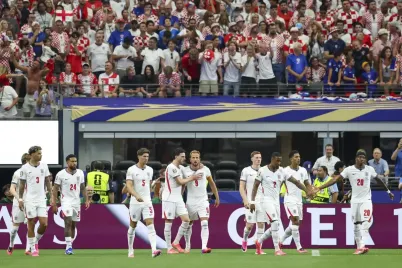
When the half-time whistle pierced the stifling, climate-controlled air of the Dallas Stadium on Wednesday night, a familiar, creeping sense of dread threatened to suffocate England’s 2026 World Cup campaign before it had even truly begun.
The scoreboard read 2-2. Despite Harry Kane’s historic double, including a retaken 12th-minute penalty and a trademark 42nd-minute finish, England looked entirely bereft of confidence. They had surrendered their lead twice. A stunning 36th-minute thunderbolt from Martin Baturina and a devastating stoppage-time volley from Petar Musa had ruthlessly exposed a fragile, back-pedalling English defence.
As the players trudged down the tunnel in Texas, the ghosts of tournaments past hovered menacingly. It was the same old story: an England side paralysed by the fear of losing, dropping into a deep, passive low block, and inviting pressure from a streetwise Croatian midfield.
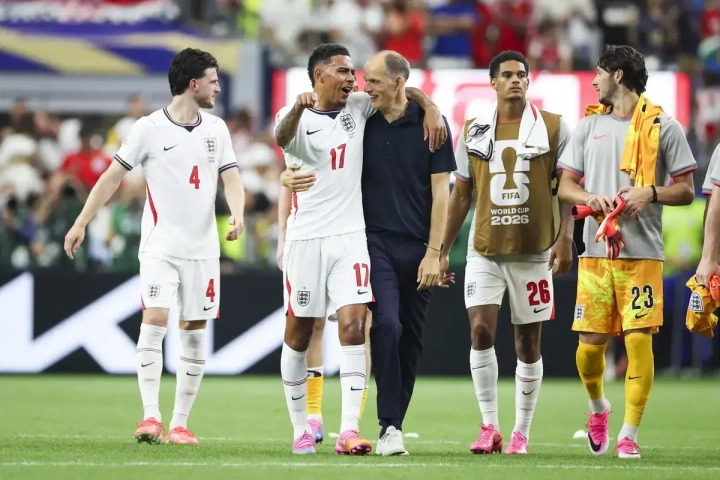
But what happened inside the dressing room over the ensuing 15 minutes marked a definitive psychological departure from previous eras. Thomas Tuchel delivered a team talk that altered not just the trajectory of the match, but potentially the entire identity of this new-look England side.
Here is the inside story of the half-time intervention that rescued the Three Lions and triggered a scintillating 4-2 victory.
The First-Half Paralysis
To understand the brilliance of Tuchel’s half-time pivot, one must first dissect the tactical and psychological failures of the opening 45 minutes.
Despite boasting a terrifying array of attacking talent, with Anthony Gordon, Noni Madueke, and Jude Bellingham operating behind Kane, England spent vast swathes of the first half playing with the handbrake firmly engaged. Against a Croatian side ranked 14th in the world but historically adept at dictating the tempo of knockout-style football, England inexplicably surrendered the initiative.
“We spent way too much time in a low block, which is also not our identity, and not what we wanted to have,” an unusually candid Tuchel admitted to the press after the full-time whistle. “The leads, both leads, didn’t make us more free. I had the impression we had to protect something now, we were punished for it, which is psychologically not easy.”
The symptoms of that psychological burden were evident all over the pitch. The backline, featuring Nico O’Reilly and Ezri Konsa, hesitated on the ball. The midfield pivot of Declan Rice and Elliot Anderson found themselves trapped in a cycle of conservative possession.
“When we could play short we played long, and when we could play long we played short,” Tuchel observed. “In the end, in doubt, we took the decision to go backwards, on and off the ball. We played way too many passes backwards, we played way too many back to our goalkeeper.”
The Intervention: Liberation Over Aggression
When a team is underperforming on the grandest stage, the traditional managerial response is the ‘hairdryer treatment’, a volley of expletives and flying teacups. Tuchel, however, opted for a far more devastating weapon: brutal, liberating honesty.
He did not scream. Instead, he systematically stripped away the suffocating pressure of the occasion. He challenged his players to embrace the very worst-case scenario and, in doing so, removed their fear of it.
Harry Kane, who walked away with the Player of the Match award after equalling Gary Lineker’s record of 10 World Cup goals, lifted the lid on the dressing room atmosphere.
“He told us to take the shackles off, calm down and let’s go,” Kane revealed. “He said, ‘What’s the worst that can happen? Show the world who we can be.’ We came out in the second half full gas and they couldn’t live with it, and that’s the level we have to set in every game.”
For a squad carrying the immense weight of a 60-year trophy drought, Tuchel’s words were a psychological masterstroke. He offered them unconditional backing, effectively telling them that the fear of failure was a heavier burden than failure itself.
“I told them to calm down. We just conceded the goal. To calm down, calm their nerves,” Tuchel elaborated later. “I told them that my perception of them in the last 17 days will not change no matter what the result is. I want them to do it their way. Our way. I want them to be brave, courageous and tenacious on the front foot. And just go for it.”
The Second-Half Blitz
The response to Tuchel’s intervention was instantaneous. It took exactly two minutes for England to demonstrate their newfound liberation.
In the 47th minute, Jude Bellingham took the game by the scruff of the neck. Driving into the box with the kind of direct, physical arrogance that defined his Real Madrid breakout, Bellingham lashed a strike past Dominik Livaković. It was the crucial 3-2 goal, but more importantly, it was a statement of intent.
From that moment, England were unrecognisable from the hesitant outfit of the first half. The low block was abandoned. The backward passes were replaced by vertical, line-breaking runs. The high press forced Croatia’s midfield, even the legendary, 40-year-old Luka Modrić, into uncharacteristic errors.
“The way we controlled the game once we went ahead, we never really looked like we were in danger,” Kane noted. “We had a spell where we could have scored three or four.”
A Display of Ruthless Depth
Tuchel’s management extended beyond the dressing room walls. As the second half wore on, his in-game adjustments proved equally decisive.
In the 71st minute, sensing that Croatia’s ageing legs were beginning to heavy under the Dallas heat, Tuchel executed a triple substitution that perfectly encapsulated England’s terrifying depth. He withdrew Gordon, Madueke, and Rice, the latter taken off as a strict precaution due to minor discomfort in his lower back and upper hamstring, and introduced Marcus Rashford, Bukayo Saka, and Morgan Rogers.
The fresh injection of pace was the final nail in Croatia’s coffin. In the 85th minute, Rashford justified his introduction, capping off a blistering transition to curl home England’s fourth and seal a 4-2 victory.
A Defining Moment for the New Era
England’s Group L campaign is only 90 minutes old, but the nature of this victory feels profoundly significant. It was not a perfect performance, the defensive frailties that allowed Baturina and Musa to score remain a glaring concern that Tuchel must address before the knockout stages.
However, the true victory in Dallas lay in the psychological shift. For decades, England teams have historically crumbled when their backs were against the wall in major tournaments, suffocated by the jersey and the expectations of a demanding nation.
On Wednesday night, Thomas Tuchel confronted that fear head-on. By demanding courage over caution, and by absorbing the pressure onto his own shoulders, he allowed his players to simply play football.
“I love the second half, all of it. I love the reaction to a very complicated first half against top opponents,” Tuchel concluded with a smile.
If this is what England looks like when the shackles are off, the rest of the world has every reason to be concerned.