
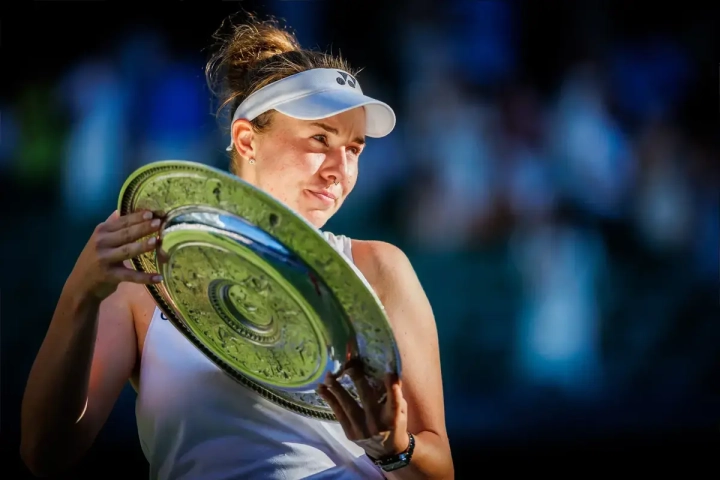
Centre Court has borne witness to countless iterations of sporting drama, but few finals in modern Wimbledon history have traversed the emotional spectrum quite like the spectacle delivered on Saturday afternoon. In a breathtaking all-Czech encounter, 21-year-old Linda Nosková conquered both Karolína Muchová and her own internal demons, surviving a catastrophic second-set collapse to secure her maiden Grand Slam title 6-2, 5-7, 6-3.
What appeared destined to be a clinical, hour-long demolition abruptly morphed into a two-and-a-half-hour psychological thriller. Nosková, possessing a devastating arsenal of baseline power, stood a single point away from the championship on five separate occasions in the second set, only to watch her seasoned compatriot mount a staggering, logic-defying comeback. Yet, in the ultimate display of mental fortitude, the young sensation regrouped in the deciding set to etch her name onto the Venus Rosewater Dish.
Aged 21 years and 236 days, Nosková becomes the youngest women’s Wimbledon champion since her compatriot Petra Kvitová triumphed in 2011. However, the historic statistics pale in comparison to the sheer emotional weight of her victory, culminating in a poignant, tear-soaked tribute to her late mother beneath the glowing London sunshine.
Here is the complete breakdown of a final that will be remembered as much for its immense vulnerability as its eventual brilliance.
The Opening Act: Clinical Baseline Dominance
When the players emerged onto the sun-drenched Centre Court turf, the contrast in their paths to the final was stark. Muchová, the wily 29-year-old tactician, had exhausted immense reserves of energy during her gruelling, match-point-saving semi-final victory over American Coco Gauff on Thursday. Nosková, conversely, arrived looking fresh, unburdened by the occasion, and armed with a brutally aggressive game plan.
From the very first exchange, Nosková dictated the tempo. The 21-year-old completely overpowered Muchová’s trademark slices, refusing to allow the older Czech the time required to construct her nuanced, all-court points. Nosková’s serving was utterly dialled in; she would go on to hammer 10 aces throughout the contest and win an impressive 74 per cent of points behind her first delivery.
Muchová, usually so composed, looked visibly overwhelmed by the sheer pace of the incoming groundstrokes. Nosková broke serve twice in rapid succession, painting the lines with flat, piercing forehands that left the Wimbledon crowd gasping. The opening set was secured 6-2 in a flash, an absolute masterclass in controlled aggression.
The momentum seamlessly carried into the second set. Nosková continued to suffocate Muchová, stepping inside the baseline to punish any short returns. When she broke again and consolidated to establish a commanding 5-2 lead, the engraver likely began tracing the letters of her name onto the trophy. The contest felt entirely concluded. Nosková was cruising, and the crowd—who inherently crave value for their exorbitant ticket prices—were baying for more tennis, hoping Muchová could at least delay the inevitable.
The Collapse: Muchová’s Miracle and Centre Court Turmoil
At 5-2 down, serving to stay in the match, Muchová tapped into the elite resilience that has defined her injury-plagued career. The dynamic of a tennis match can hinge on a single, fragile thread of momentum, and what unfolded next was an extraordinary collapse of nerve from the youngster.
Nosková generated her first championship points. The finish line was agonisingly close, but the 21-year-old’s arm suddenly grew heavy. The relentless, punishing forehand that had dictated the entire afternoon abruptly broke down. Unforced errors began flying off her racquet frame as the magnitude of the moment seemingly paralysed her.
Muchová, sensing the suffocating tension enveloping her opponent, completely changed her tactical approach. She began utilising looping topspin to push Nosková deep, mixed with wicked, skidding slices that demanded the youngster generate her own pace. Nosková squandered a staggering five championship points across two separate games. Each missed opportunity drained the colour from her face and amplified the roar of a Centre Court crowd that had firmly aligned itself with the underdog’s revival.
When Muchová broke back to level the set at 5-5, Nosková’s calm, stoic demeanour vanished entirely. She screamed in sheer frustration, waving frantically and despairingly at her coaching box, who looked back with faces just as stunned and horrified as her own. The 21-year-old had completely unravelled. Muchová ruthlessly capitalised on the panic, holding her serve and breaking a disintegrated Nosková once more to snatch the second set 7-5.
As Nosková marched to her chair, pressing her fingers into her ears to drown out the deafening cheers that were entirely for her opponent, a catastrophic defeat looked highly probable. She had spent 40 minutes watching a Grand Slam title slip through her trembling fingers.
The Decider: A Herculean Reset
Tennis is notoriously described as boxing without ropes; there is nowhere to hide when the mental unravelling begins. Entering the deciding third set, the psychological momentum was entirely with Muchová. The veteran had miraculously converted two of her 15 breakpoint opportunities during the match, doing so precisely when the pressure was at its absolute zenith.
Yet, the true measure of a champion is not how they perform when the ball is striking the sweet spot, but how they respond when the entire world expects them to collapse. Following a lengthy bathroom break to reset her focus, Nosková returned to the court and demonstrated a level of mental fortitude that belied her years.
She wiped the slate clean. Abandoning the frantic, rushed shot selection that had plagued her at the end of the second set, Nosková returned to the first-serve dominance that had established her early lead. She dug deep, winning gruelling baseline rallies and gradually silencing Muchová’s resurgence.
The critical breakthrough arrived in the sixth game of the decider. Nosková, finding the acute angles once again, forced Muchová into a desperate defensive lob that landed agonisingly wide, securing the vital break of serve. From there, the 21-year-old refused to blink twice. Serving for the championship at 5-3, the ghosts of the second set were firmly banished. She fired down a colossal first serve, put away the resulting short ball, and collapsed flat onto her back on the baseline as Muchová’s final desperate return floated long.
After two hours and 29 minutes of sheer tactical and emotional warfare, Linda Nosková was a Grand Slam champion.
A Poignant Coronation: “I Would Not Be Standing Here Without Her”
The post-match presentation provided an emotional crescendo that left very few dry eyes inside the iconic arena. For Nosková, this victory was the culmination of a deeply personal and heartbreaking journey. Just two years ago, on the eve of her Wimbledon appearance and subsequent Olympic debut at Paris 2024, the young Czech tragically lost her mother, Ivana Nosková, to cancer.
As she clutched the Venus Rosewater Dish, the magnitude of the moment finally washed over her. With a weakened voice and welling tears, she addressed the crowd and her family box.
“I want to thank my dad for coming here, my family for flying here, I know you don’t like flying so I appreciate it,” Nosková smiled through the tears, acknowledging her father’s rare presence in her team box.
She paused, taking a deep, shuddering breath as the stadium fell into a profound, respectful silence.
“There is one more person I’d like to thank. I’d like to thank my mum. I would definitely not be standing here without her, so thank you very much.”
A solemn look and a tender kiss blown toward the sky served as the ultimate tribute. Her mother may not have been physically present to witness her daughter’s crowning achievement, but as the crowd erupted into a sustained, thunderous standing ovation, the spirit of her dedication resonated throughout the grounds of SW19.
The Dawn of a New Era
Saturday’s final represents a significant changing of the guard in the women’s game. The Czech Republic has historically produced some of the sport’s most elegant and ruthless champions, becoming only the seventh country in the Open Era to have two countrywomen contest a major singles final. With this victory, Nosková officially assumes the mantle as the leader of the next generation.
For Karolína Muchová, the defeat is undoubtedly a bitter pill to swallow. She contributed immensely to a classic final, capturing 92 points overall and showcasing the unparalleled grit and tactical variety that makes her one of the most aesthetically pleasing players on the WTA Tour.
However, the 2026 Championships belong entirely to Linda Nosková. She arrived at the All England Club as a highly touted prospect and leaves as a major champion who stared down a historic sporting collapse and refused to be broken. It was a victory built on devastating power, nearly destroyed by youthful panic, and ultimately secured by an unforgettable, champion’s resolve.