The sprawling, state-of-the-art expanse of the Los Angeles Stadium sets the spectacular stage for a truly pivotal Group B encounter this Thursday, as Switzerland prepare to face a fiercely resilient Bosnia and Herzegovina side in the 2026 FIFA World Cup. Scheduled for an evening kick-off at exactly 20:00 BST on 18 June 2026, the highly anticipated fixture carries immense weight for both European nations. Having each endured deeply frustrating stalemates in their respective opening fixtures, the margin for error has rapidly evaporated. For the Swiss, the match represents a crucial opportunity to assert their traditional tournament pedigree, while the Dragons of Bosnia are determined to emphatically prove their sensational qualification journey was no mere statistical anomaly.
The broader landscape of Group B remains tantalisingly poised on a knife-edge, with all four competing teams currently deadlocked on a single point following the dramatic opening round. The expanded 48-team World Cup format theoretically provides a slightly wider safety net for qualification, yet neither manager will be eager to rely on the precarious mathematics of third-place progression. A comprehensive victory under the Californian lights would immediately propel either nation into the undisputed driving seat for automatic qualification to the newly introduced Round of 32. Conversely, a damaging defeat would necessitate a desperate, high-wire act in the final, nerve-wracking group matches scheduled for next week.
For Switzerland, the immediate build-up to this crucial encounter has been heavily dominated by a profound sense of what might have been. Under the meticulous, tactically astute guidance of head coach Murat Yakin, the national side have firmly established themselves as one of Europe’s most remarkably consistent teams over the past eighteen months. They arrived in North America having suffered just a single defeat—a narrow loss to tournament heavyweights Germany—in a prolonged 15-match sequence. However, their highly anticipated World Cup opener against Asian champions Qatar ended in a bitter, profoundly frustrating disappointment.
Despite monopolising the lion’s share of possession and establishing a thoroughly deserved lead through a characteristic, powerful strike from forward Breel Embolo, the Swiss were ultimately punished for their glaring wastefulness in the final third. Failing to ruthlessly put the game out of reach, they suffered late heartbreak when a devastating 93rd-minute own goal off the boot of defender Miro Muheim allowed the Qataris to steal a dramatic 1-1 draw. The late collapse left Yakin’s men grappling with a deep sense of missed opportunity.
To rectify those opening-day shortcomings, the Swiss coaching staff will undoubtedly demand significantly greater clinical precision. The established tactical blueprint relies heavily on a composed, possession-based approach, anchored firmly by a deeply experienced midfield core. Remo Freuler and Michel Aebischer are explicitly tasked with dictating the overarching tempo of the match and providing the necessary structural platform for progressive attacks. Furthermore, the veteran presence of Ricardo Rodríguez on the defensive flank offers vital overlapping width and unyielding defensive stability. The primary objective against the Balkan nation will be to seamlessly translate their anticipated dominance of the ball into clear-cut goalscoring opportunities, completely avoiding the subtle complacency that allowed their previous opponents a route back into the contest.
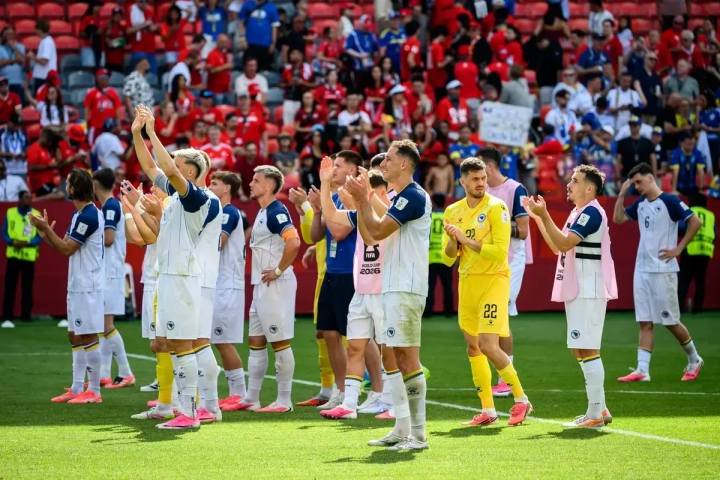
Opposing them is a Bosnian outfit currently surfing a massive, undeniable wave of national emotion and sporting pride. Sergej Barbarez’s tightly knit squad arrived in the United States having orchestrated one of the most astonishing qualification narratives in recent international memory. Universally written off ahead of the UEFA play-off finals, the Dragons produced a truly seismic shock by comprehensively eliminating four-time world champions Italy. A dramatic, last-gasp equaliser from Haris Tabaković forced a tense penalty shootout, which the exceptionally brave Bosnians subsequently won to secure their second-ever global finals appearance, successfully banishing the lingering ghosts of their 2014 debut in Brazil.
However, their eagerly anticipated 2026 World Cup debut also concluded with a distinct feeling of a squandered advantage. Squaring off against passionate co-hosts Canada, the Balkan nation established a crucial early lead but ultimately failed to consistently repel the subsequent waves of Canadian pressure, eventually settling for a hard-fought, physically draining 1-1 draw.
As they meticulously prepare for the formidable Swiss challenge, Barbarez is facing severe, complex selection headaches regarding the physical condition of his most vital personnel. Captain and undisputed defensive talisman Sead Kolašinac was forced to prematurely exit the Canadian fixture due to a concerning injury, leaving the experienced Atalanta left-back’s availability for Thursday in serious, lingering doubt. Losing his vocal leadership and aggressive, overlapping defensive runs would constitute a massive, potentially destabilising blow to the team’s structural integrity.
Further up the pitch, the Bosnian coaching staff must carefully manage a highly complex attacking dynamic. The legendary Edin Džeko, still proudly leading the line at 40 years of age, remains an incredibly potent aerial threat and a monumental, inspiring figure within the dressing room. Yet, genuine questions naturally persist regarding his physiological ability to successfully negotiate the intense, unrelenting physical demands of consecutive high-stakes tournament matches within a heavily condensed timeframe.
Should Barbarez opt for a more energetic, high-intensity pressing system from the front, he may turn to the hero of their qualification campaign, Tabaković, provided the forward is deemed fully fit to start. Alternatively, the heavy responsibility of spearheading the preferred 4-4-2 formation alongside the dynamic Ermedin Demirović could fall to emerging, youthful talents such as Milan Lukić, all eager to cement their permanent legacy on the grandest international stage.
The contrasting stylistic philosophies of the two proud nations present a fascinating, highly intellectual tactical chessboard for neutral observers. While Switzerland will inherently seek to control the passing rhythm and meticulously probe for momentary defensive gaps, Bosnia and Herzegovina are fully expected to weaponise a highly disciplined, remarkably compact organisational structure. Under Barbarez’s instructions, they will patiently lie in wait, ready to strike via rapid, incisive vertical transitions.
Anticipated Tactical Battlegrounds
Area of the Pitch | Swiss Personnel | Bosnian Personnel | Tactical Significance |
Central Midfield | Remo Freuler & Michel Aebischer | Benjamin Tahirović & Amar Memić | The ultimate battle for possession dominance. The energetic Bosnian duo must aggressively disrupt the Swiss playmakers to prevent prolonged, suffocating attacking pressure. |
The Penalty Area | Breel Embolo | Nikola Katić & Amar Dedić | Embolo’s immense physical hold-up play against a resolute, uncompromising Bosnian central defensive block will be undeniably pivotal in determining the final outcome of Swiss attacks. |
The Wide Channels | Ricardo Rodríguez | Esmir Bajraktarević | Rodríguez’s vast, elite tournament experience against the raw, youthful exuberance of the Bosnian wide players. Preventing accurate crosses into the danger zone is absolutely crucial for both defensive units. |
The ultimate outcome of the Los Angeles encounter may very well be decisively settled within the congested, physically demanding central midfield zones. The Bosnian engine room, heavily reliant on the tireless, unyielding work rate of Benjamin Tahirović and Amar Memić alongside Ivan Bašić, must execute a virtually flawless pressing trigger. If they can successfully and aggressively track advanced runners, explicitly disrupting the deep Swiss build-up phases before possession is comfortably consolidated, they can generate the exact transition errors their forwards desperately crave. Conversely, if the technically gifted Freuler and Aebischer are afforded the necessary time and space to dictate the passing angles, the Bosnian defensive line—marshalled by goalkeeper Nikola Vasilj and defender Tarik Muharemović—will inevitably face an exhausting, unrelenting siege.
As the thousands of brightly clad, passionately vocal travelling supporters prepare to descend upon the magnificent architecture of the Los Angeles Stadium, the exhaustive theoretical planning, rigorous training sessions, and meticulous video analysis conclusively end. With a potentially decisive group-stage clash against Canada awaiting the Swiss next week, and an equally demanding fixture against Qatar looming large for the Dragons, neither side can afford the ultimate luxury of patience or excessive tactical caution.
The upcoming ninety minutes promise to deliver a truly captivating, unforgettable blend of elite European technical proficiency and unyielding, courageous Balkan resilience. For Murat Yakin’s Switzerland, it is an absolute, non-negotiable necessity to rapidly discover their clinical edge and emphatically justify their pre-tournament billing as the heavily favoured group heavyweights. For Sergej Barbarez’s Bosnia and Herzegovina, it represents yet another golden, glorious opportunity to completely defy the mounting odds, wholeheartedly embrace their underdog status, and register a historic, monumental victory that would undoubtedly send major shockwaves throughout the entirety of the 2026 tournament. Football fans across the globe can rightfully anticipate an intensely competitive, high-octane affair under the Californian sky, where fleeting moments of sheer individual brilliance or momentary, devastating lapses in concentration will unequivocally define their respective World Cup destinies.