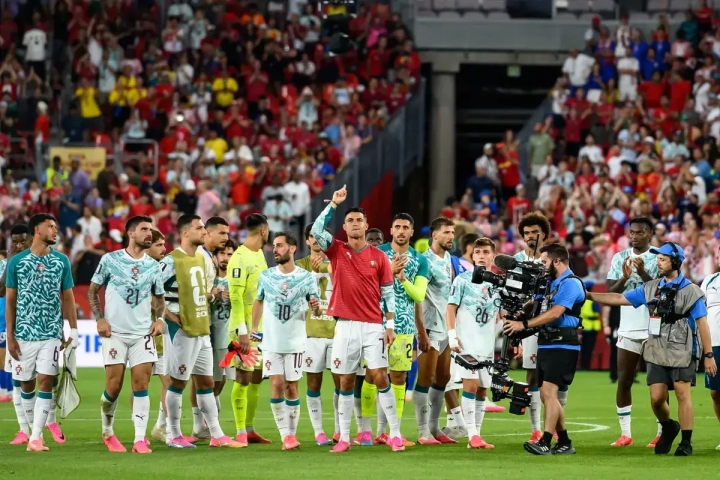
The vibrant city of Toronto, Canada, served as a truly magnificent host for a FIFA World Cup 2026 Round of 32 encounter that will undoubtedly be etched into footballing folklore. Kicking off exactly at midnight (00:00 BST) on Friday, 3 July 2026, the Toronto Stadium witnessed a gruelling, 109-minute tug-of-war between two European heavyweights. In a fixture defined by intense tactical battles, historic milestones, and unparalleled late drama, Roberto Martínez’s Portugal completed a sensational second-half comeback to defeat Zlatko Dalić’s Croatia 2-1.
For the Iberian giants, the hard-fought triumph secures a highly anticipated Round of 16 berth against regional rivals Spain, keeping their ultimate tournament aspirations alive. Conversely, the heartbreaking nature of the late collapse marks a cruel conclusion to Croatia’s campaign, sending the 2018 finalists home after pushing their illustrious opponents to the absolute physical and psychological limit.
A Cagey Opening Period
Heading into the highly consequential fixture, both managers opted for pragmatic approaches tailored to neutralise their respective opponents. Operating in fluid 4-2-3-1 formations, the initial exchanges were overwhelmingly characterised by intense midfield battles and an abundance of caution. Diogo Costa started between the posts for the Portuguese, shielded by a robust defensive line featuring João Cancelo, Rúben Dias, Renato Veiga, and Nuno Mendes. Across the tactical divide, Croatia relied on the immense experience of Luka Modrić and Mateo Kovačić to dictate the tempo and disrupt the opposition’s passing rhythms.
Despite the cagey nature of the opening forty-five minutes, flashes of attacking brilliance occasionally illuminated the Canadian evening. The Portuguese almost snatched an incredibly early advantage in the fourth minute. Showcasing his blistering pace, Rafael Leão successfully bypassed the Croatian defensive structure and delivered a precise cut-back into the penalty area. Bruno Fernandes met the delivery with a firm strike, but goalkeeper Dominik Livaković produced a sharp save before Josip Šutalo crucially blocked the midfielder’s subsequent rebound effort.
Pedro Neto also proved to be a persistent menace on the right flank, repeatedly isolating his marker. The dynamic winger sent a wicked, curling cross into the six-yard box that seemed destined for the head of Cristiano Ronaldo, only for the ball to narrowly evade the veteran striker. The physical toll of the encounter was established early, perfectly illustrated when Rúben Dias received a yellow card in the 16th minute for a robust challenge. However, neither side could find the elusive breakthrough before the half-time interval.
The Second-Half Spark and Croatian Advantage
Recognising the urgent necessity for fresh attacking impetus, Dalić initiated a crucial substitution at the break, introducing Igor Matanović in place of Ante Budimir. The tactical alteration injected immediate energy into the Croatian ranks, allowing them to press higher up the pitch and force turnovers in dangerous areas.
Their elevated intensity yielded a tangible reward shortly after the restart. In the 53rd minute, the persistent deadlock was finally shattered. Nikola Vlašić and Josip Stanišić orchestrated a beautifully intricate passing sequence down the right channel. Stanišić subsequently whipped a highly inviting cross towards the far post, where Ivan Perišić had intelligently drifted away from his marker. The experienced winger made absolutely no mistake, firing a clinical finish past Costa to provide the Balkan nation with a precious 1-0 lead.
Croatia genuinely believed they had doubled their advantage moments later when Vlašić delivered a low cross for substitute Matanović to slide home. However, the celebrations were abruptly curtailed as the linesman correctly raised his flag for offside, offering the Portuguese a vital lifeline.
Martínez Rolls the Dice
Stung by the concession and visibly frustrated on the touchline, Martínez delivered a decisive, game-changing tactical intervention shortly after the hour mark. In a sweeping quadruple substitution, the Spanish manager completely revitalised his team’s creative machinery. Bernardo Silva, Francisco Conceição, Nélson Semedo, and Gonçalo Ramos were all simultaneously introduced into the fray, replacing Vitinha, Pedro Neto, Bruno Fernandes, and João Cancelo.
The alterations instantaneously altered the dynamic of the encounter, generating wave after wave of suffocating pressure. Leão came agonisingly close to restoring parity, cutting inside from the left wing and rattling a ferocious effort directly against the crossbar. Ronaldo also experienced the frustration of the offside flag, brilliantly controlling a high ball and executing a sumptuous dink over Livaković, only to discover he had mistimed his initial run.
A Milestone for the Captain
The mounting, unrelenting Portuguese pressure inevitably forced a critical error from the Croatian defence. Earning a corner in the 68th minute, the towering Renato Veiga was unceremoniously dragged to the ground inside the penalty area by Vlašić. Following a swift Video Assistant Referee (VAR) review, the referee pointed directly to the spot.
Shouldering the immense weight of national expectation, captain Cristiano Ronaldo confidently stepped up to take the resulting penalty kick. The 41-year-old superstar maintained absolute composure, calmly dispatching his shot straight down the middle of the goal to level the scoreline. The equaliser carried profound historical significance, marking Ronaldo’s 11th career World Cup goal. Crucially, it represented his very first goal in the knockout stages of the competition, officially establishing him as the oldest player to ever score in a World Cup knockout match.
Stoppage-Time Chaos and VAR Intervention
As the match entered its closing stages, the tension reached a boiling point. Both goalkeepers were forced into heroic interventions to keep their respective nations in the tournament. Costa produced a magnificent, sprawling save to deny a long-range thunderbolt from Kovačić, before remarkably tipping the midfielder’s follow-up attempt onto the post. At the opposite end, Livaković remained an assured presence, securely gathering a series of dangerous crosses.
Just as the exhausting prospect of extra time loomed incredibly large over the tiring players, Portugal delivered a devastating final blow. In the 94th minute (90+4′), the exceptionally lively Leão carved out a pocket of premium space on the left flank. He delivered a tantalising, curling cross directly into the heart of the penalty area. Substitute Gonçalo Ramos timed his run to absolute perfection, rising majestically above the Croatian defenders to power an unstoppable header into the back of the net. The spectacular stoppage-time winner sparked scenes of unrestrained, chaotic delirium on the Portuguese bench.
Incredibly, the drama was far from concluded. With the electronic board indicating ten minutes of added time, Croatia launched a desperate, Hail Mary assault. Deep into the 103rd minute, Perišić delivered an in-swinging cross from the left wing. Matanović managed the slightest of headed flicks, causing the ball to ricochet off Mario Pašalić’s thigh and roll across the face of the goal. Substitute Joško Gvardiol lunged desperately, crashing the ball into the net and sending the Croatian supporters into raptures.
However, the unbelievable sequence was subjected to an agonisingly lengthy VAR review. Sensor technology embedded within the match ball conclusively proved that Matanović had indeed made contact with the initial cross. Because Pašalić was standing in an offside position at the exact moment of that touch, the goal was dramatically ruled out by referee Espen Eskås. The decision incensed the Croatian contingent, resulting in a delayed restart, but Portugal successfully navigated the remaining minutes until the final whistle mercifully blew in the 109th minute.
Match Statistics and The Road Ahead
When analysing the underlying statistical narrative, the 2-1 victory provides a fair reflection of sustained territorial dominance. Controlling 60 percent of the overall possession and completing an impressive 91 percent of their passes, Portugal successfully dictated the tempo for large periods. Generating 15 shots compared to Croatia’s 13, and winning nine corners to their opponents’ five, the victors eventually made their undeniable technical quality count.
This hard-fought triumph guarantees the Seleção a safe passage to the Round of 16, where they will embark on a highly anticipated journey to Dallas. There, they will face familiar Iberian rivals Spain on 6 July in what promises to be a spectacular, high-stakes encounter. Having demonstrated immense character and resilience to overcome a tactical masterclass from a seasoned opponent, Martínez’s squad carries immense momentum as they continue their pursuit of international football’s most coveted prize.
For Croatia, the heartbreak of the incredibly late defeat will eventually subside, replaced by an immense sense of national pride. They depart North America having provided one of the most compelling, nerve-shredding narratives of the tournament, proving they remain a formidable force capable of testing the very best teams on the planet.
Official Match Facts
| Detail | Information |
| Competition | FIFA World Cup 2026 – Round of 32 |
| Venue | Toronto Stadium, Ontario, Canada |
| Date | 2 July 2026 (Local) / 3 July 2026 (BST) |
| Final Score | Portugal 2 – 1 Croatia |
Goalscorers:
Croatia: Ivan Perišić (53′)
Portugal: Cristiano Ronaldo (68′ pen), Gonçalo Ramos (90+4′)
Discipline:
Portugal: Rúben Dias (Yellow Card, 16′)
Croatia: Luka Modrić (Yellow Card, 58′), Ivan Perišić (Yellow Card, 90+7′)