There are very few athletes in the history of global sport who possess the sheer gravitational pull required to bring the world to a standstill simply by walking onto a patch of grass. Last night, 28 years after she first set foot on the hallowed turf of the All England Lawn Tennis and Croquet Club, Serena Williams proved that her aura remains entirely undiminished.
Stepping out of an almost four-year retirement to accept a heavily debated wildcard, the 44-year-old American took to Centre Court on Tuesday evening. What followed was a classic, high-octane Serena Williams encounter. While a fairytale victory ultimately proved beyond her, falling to a 6-3, 6-7(6), 6-3 defeat against 20-year-old Australian Maya Joint in two hours and 22 minutes, the performance was a staggering display of competitive fire from a woman who had not played a competitive singles match since the 2022 US Open.
Here is a look back at an unforgettable evening in SW19, where tennis tradition met modern greatness, and a young Australian seized the moment of a lifetime.
A Royal Welcome: The Atmosphere on Centre Court
The excitement rippling through the Wimbledon grounds on Tuesday was palpable for hours before the match. When the wooden doors of Centre Court finally swung open, the capacity crowd rose in unison, delivering a deafening, roaring standing ovation.
It was a deeply poignant moment. Williams became the oldest player to feature in the women’s singles draw at Wimbledon since a 47-year-old Martina Navratilova in 2004. Yet, this comeback felt uniquely personal. In the days leading up to the tournament, the 23-time Grand Slam singles champion admitted she had virtually no expectations regarding her on-court performance. Her primary motivation was intensely familial: she wanted her two young daughters, eight-year-old Olympia and two-year-old Adira, to witness their mother compete on the world’s most famous tennis stage.
Both girls were sat front and centre in the Williams player’s box alongside Serena’s sister, Venus, with Olympia taking a highly vested, animated interest in every point her mother played.
“I never expected to be here,” a reflective Williams said via a press statement following the match. “It was really great to be back at Wimbledon. The atmosphere was amazing; walking out was amazing. I definitely relished and missed it, and enjoyed the moment more than anything.”
The Anatomy of a Thriller
When the warm-ups concluded and the umpire called “Play,” the romanticism immediately gave way to the brutal, physical reality of the modern WTA Tour.
Set 1: Joint Handles the Occasion
Maya Joint, currently ranked World No. 87, deserves immense credit for her tactical discipline. Facing an opponent 24 years her senior, the young Australian could have easily been overwhelmed by the magnitude of the occasion. Instead, she was an incredibly steady force from the baseline.
Exploiting Williams’ inevitable early rust and lack of lateral movement, Joint served beautifully, eventually firing 10 aces across the match. She absorbed the American’s heavy groundstrokes and forced Williams into long, lung-busting rallies. Joint secured an early break and comfortably closed out the first set 6-3, threatening to turn the historic evening into a remarkably brief procession.
Set 2: The Vintage Serena
Just as the obituaries for her comeback were being drafted in the press box, the vintage, terrifyingly resilient version of Serena Williams arrived.
The second set was a theatre of pure drama. Williams fell a break down on two separate occasions, looking visibly fatigued between points. Yet, fueled by the partisan Centre Court crowd urging her through every swing, she fought her way back into contention, forcing a tie-break.
At 5-6 down in the breaker, facing match point, the tension was suffocating. In trademark fashion, Williams produced a blistering, unreturnable serve to save the match, sending the crowd into delirium. She rattled off the next two points, clinching the tie-break 8-6 and forcing a deciding third set. For a fleeting 15 minutes, it felt as though we had been transported back to 2016.
Set 3: The Physical Reality Sets In
The momentum had entirely shifted. Pouncing on a flustered Joint, Williams secured an early break in the deciding set, racing into a 2-1 lead. It appeared the 44-year-old was about to script one of the most incredible victories in recent Wimbledon history.
However, the sheer physical toll of elite-level grass-court tennis, particularly after a four-year hiatus, ultimately dictated the outcome. As Williams’ first-serve percentage dropped and her footwork slowed, Joint remarkably raised her own level. The 20-year-old hit through the ball with renewed conviction, winning five of the final six games of the match.
On her third match point, Joint pushed Williams deep into the ad-court corner. The American desperately lunged, drawing a forehand return long, and bringing the curtain down on her remarkable singles return.
The Opponent: Maya Joint’s Coming of Age
While the narrative was entirely monopolised by Williams, the significance of the victory for Maya Joint cannot be overstated.
The Australian arrived in South West London desperately out of form, having endured a brutal 11-match losing streak on the WTA tour that stretched all the way back to January. To snap that streak on Centre Court, against the greatest player of the Open Era, is a monumental feat of mental fortitude.
A shell-shocked Joint was almost lost for words during her on-court interview.
“I didn’t get much sleep last night, I was up till 2am just thinking about it,” she admitted to the crowd, still clutching her racket. “Wow… I don’t know what just happened, to be honest. She has such an aura; she’s such a legend. I’ve been dreaming about this moment since I was a little kid, so this is pretty crazy.”
Joint now advances to the second round, carrying the ultimate badge of honour and a massive injection of confidence as she looks to navigate the rest of the grass-court season.
The Legacy and the Next Chapter
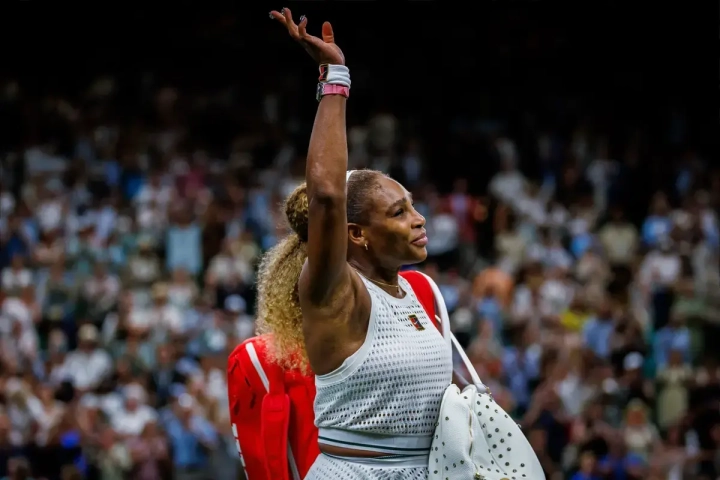
As Serena Williams waved to all four corners of Centre Court, taking her leave to a second, prolonged standing ovation, the overarching feeling was not one of disappointment, but of profound appreciation.
The depth, power, and physicality of the modern tennis tour are on a completely different level now than they were even a decade ago. For a 44-year-old mother of two to walk off the street and push a top-100 player to the absolute brink in a two-and-a-half-hour slugfest defies athletic logic.
Furthermore, the Wimbledon faithful have not seen the last of the Williams family this fortnight. The singles return was merely the opening act. Tomorrow (Thursday, 2 July), Serena and Venus Williams will reunite on the doubles court. The six-time Wimbledon doubles champions will once again don their pristine whites, playing together at the All England Club for the first time in a decade.
Her singles campaign may have ended in defeat, but Tuesday night proved exactly why Serena Williams returned. She didn’t come to pad her unparalleled statistics; she came for the sheer, unadulterated joy of the fight, the roar of the crowd, and the chance to show her daughters exactly who their mother is. In that regard, her comeback is already a resounding triumph.