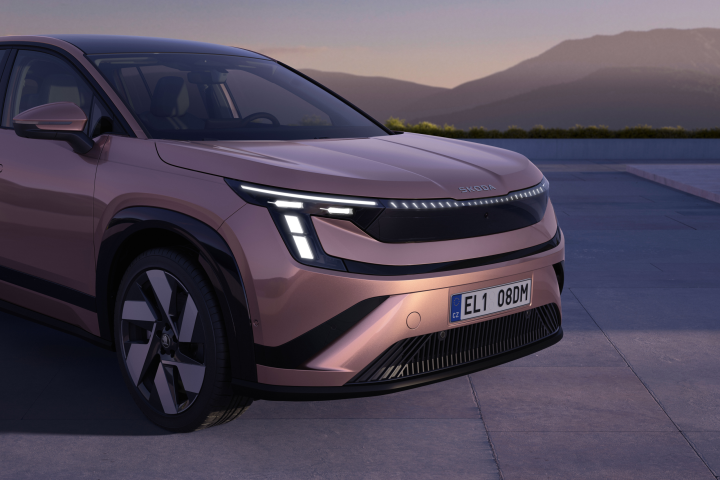
The European New Car Assessment Programme (Euro NCAP), an independent vehicle-safety organisation, has awarded the new all-electric Škoda Peaq its maximum five-star safety rating. Under Euro NCAP’s 2026 assessment protocol, the tested left-hand-drive Peaq Selection 90 achieved the highest-ever score in Crash Protection, with 94 per cent. It also became the first model to receive full points for occupant protection across all assessed crash configurations. The Peaq scored 92 per cent for Post-Crash Safety, 78 per cent for Crash Avoidance and 65 per cent for Safe Driving.
Škoda Auto Chief Development Officer Johannes Neft says: “With the Peaq’s five-star Euro NCAP rating, Škoda continues its strong track record in vehicle safety. This excellent result also demonstrates that our new all-electric SUV fully meets the particularly high standards we set for our flagship across all areas of vehicle development, with safety being integral from the outset. This achievement reflects our team’s expertise and great commitment. I want to thank everyone involved for their dedication and excellent work.”
In the Crash Protection category, the SUV achieved Euro NCAP’s highest-ever score of 94 per cent. It also became the first model to receive full points for occupant protection across all the assessed crash configurations listed below:
- Offset frontal impact: protection for the driver, front passenger and children aged 6 and 10.
- Full-width frontal impact: protection for the driver and passengers in the front and rear seats.
- Side mobile-barrier impact: protection for the driver and children aged 6 and 10.
- Side-pole impact: protection for the driver.
- Rear impact: protection for the driver and passengers in the front and rear seats.
Protection for vulnerable road users scored highly in both head-impact and pelvis and leg-impact tests. Both the five- and seven-seat variants also passed the child-seat installation check. They accommodate i-Size and ISOFIX child restraints, as well as seat-belt-secured child restraint systems, in forward- and rear-facing configurations in both the front and rear seats.
In the Post-Crash Safety category, the Peaq scored 92 per cent. It received maximum points for providing four-page rescue sheets in 23 official EU languages and a 100-page emergency rescue guide, available in English, German, Spanish and French.
The Peaq’s airbag control unit includes an event data recorder, and the vehicle has an advanced eCall system. When the restraint systems are deployed, eCall automatically sends the emergency services the vehicle’s location, speed at impact, type of impact and number of belted occupants, among other information. A multi-collision braking system helps reduce the severity of secondary impacts.
The Peaq also met the thermal-propagation requirements for more than 20 minutes and passed the new submergence requirements. Both front side windows remained operational for well over two minutes after the vehicle entered the water.
In the Crash Avoidance category, the Škoda Peaq achieved 78 per cent. Its assistance systems were assessed in approximately 1,000 test cases involving cars, powered two-wheelers, cyclists and pedestrians, including frontal, lane-departure and low-speed collisions.
In the Safe Driving category, the Peaq scored 65 per cent. It is the first Škoda model equipped with a system that detects the size of the driver and front passenger, so that front-airbag deployment and the force of the seat-belt load limiter can be optimised for each occupant’s size.
An interior camera integrated into the rear-view mirror alerts the driver if the seat belt is worn incorrectly, for example, if only the buckle is fastened, the belt is behind the back or only the lap belt is in use. The camera also supports advanced driver-attention and drowsiness assistance, detecting brief or prolonged distraction, mobile-phone use, impairment, sleep and an unresponsive driver.
Euro NCAP now also assesses controls for driving, comfort and infotainment functions. The Peaq achieved the maximum score in this area; its haptic buttons and voice control reduce the need to use the touchscreen.
For Vehicle Assistance, Euro NCAP tests vehicles’ recognition of supplementary traffic signs on an on-road route covering more than 2,000 km across four EU countries. It assesses conditional signs (rain, snow, time, distance and vehicle categories), implicit signs (motorways, city entrances and residual areas), dynamic signs (lane-relevant and non-lane-relevant) and speedometer accuracy. Škoda’s Traffication app uses cloud-based communication to alert drivers to local hazards.
Euro NCAP is a consortium of transport ministries, motoring organisations, insurance associations and research institutes from several European countries. Established in 1997 and based in Leuven, Belgium, it conducts independent safety assessments of new vehicles.