
A new trial has shown that using telepresence robots to support the well-being and health of older people in their homes can improve physical strength and balance, as well as social interaction and confidence.
Experts from the University of Nottingham worked with Age UK Bristol to explore how telepresence robots might offer a means to connect people, and more importantly, explore the opportunities and barriers to providing support for physical exercise, alongside social interaction.
Frailty, social isolation, and loneliness have individually been associated with adverse health outcomes. Falls due to frailty are the main cause of a person losing their independence and going into long term care, with more than one in three people over 65 having a fall. After a fall, the fear of falling can lead to more inactivity, loss of strength and confidence, and a greater risk of social isolation, further falls and risk of death.
Telepresence robots have emerged as a market-ready communication technology which enables two-way video communication, without people needing to set-up any software or have any digital skills, while allowing for social interaction with other people. Telepresence robots uniquely enable people connecting remotely to be perceived as being “present” with the person being supported. While people can connect via Facetime and Zoom, they cannot move freely around a space as if “present”.
For this trial volunteers from Age UK Bristol’s volunteer service were selected and trained, and were paired up with an older person to engage in regular social interactions and exercise via a telepresence robot situated in the older person’s home over a 6-week period, two to three times a week. The volunteers were also trained on using the telepresence robot, and how best to safely guide and encourage the older person they were buddied-up with through a personalised physical activity exercise plan developed by a fitness instructor.
The assessments showed small reductions in physical frailty, and improved confidence in the older person to begin to socialise outside their home, as well as increased digital literacy for volunteers and older adults. The findings provide insights into emotional, logistic, and technical challenges, together with a deployment framework, including protocols and materials to support larger studies in community settings.
This research is forming part of a parliamentary round table to explore the barriers to the safe, effective and sustainable adoption of intelligent assistive robotics in health and social care, and how these barriers might be addressed.
Praminda Caleb-Solly, Professor of Embodied Intelligence in the School of Computer Science is leading this work at the University of Nottingham and said: “Our research has shown the benefits to older people who adopt the use of technology in their everyday life and seen that it makes a positive difference, but we need to work together with government and partners to translate this research into application.”
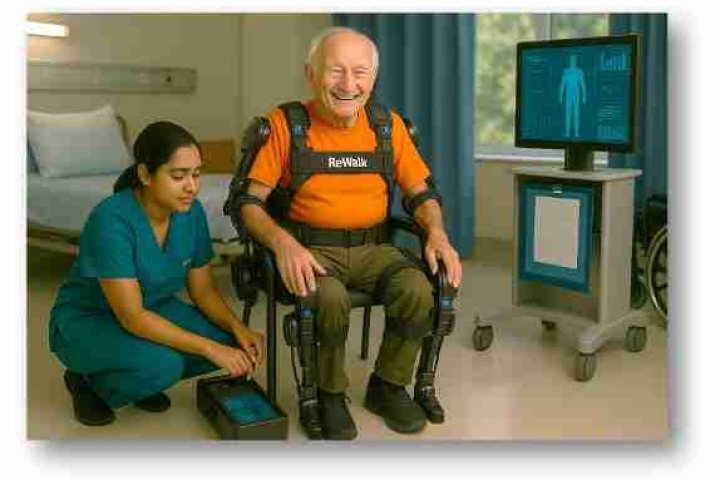
Intelligent assistive robotics offer huge potential for supporting health and well-being, from exoskeletons that support mobility, to robotic devices that enable people with limited fine motor control to eat independently. However, many promising technologies remain difficult to adopt at scale, particularly in people’s homes, care settings and routine clinical pathways.
Research is imperative to identify gaps in existing policies, care standards and procurement pathways at the institutional level and crucially, to identify the tensions arising from introducing these technologies at scale, to inform policy and workforce capability building to facilitate adoption. Building on EMERGENCE EPSRC Healthcare Technologies Network+ Robotics in Health and Social Care White Paper, a new project, Future-Proofing Care at University of Nottingham led by Professor Caleb-Solly, has been focussing on policy engagement and participatory research to understand how to accelerate real-world adoption of intelligent assistive robotic healthcare technologies in the UK.
The Future-Proofing Care project team has partnered with the cross-party think tank Policy Connect to host a parliamentary roundtable – Easing the Adoption of Intelligent Assistive Robotics that will inform recommendations to government on areas including standards, procurement, skills, sustainability, regulation and implementation.
Read the full paper here: https://ieeexplore.ieee.org/abstract/document/11521328