
With almost three million passengers set to take to the skies across England and Wales this October half-term, the UK Civil Aviation Authority is urging passengers to follow its new lithium battery safety checklist, warning that incidents involving lithium battery-powered devices remain highly likely during this busy travel period.
The simple checklist is designed to help passengers recognise the warning signs of an incident and respond quickly if a lithium battery-powered device overheats, starts smoking or catches fire onboard an aircraft.
New research commissioned by the Civil Aviation Authority suggests awareness of lithium battery safety among passengers has improved following a summer-long awareness campaign by the regulator, airports and airlines across the UK.
The survey found that awareness of lithium battery travel rules has increased to 86% among recent flyers, up from 81% last year. Yet almost one in three passengers (31%) still incorrectly believe that items containing lithium batteries should be packed in checked luggage, showing that awareness does not always translate to understanding.
Awareness of packing requirements is only part of the safety picture. More than half (54%) of air passengers now carrying a power bank when they fly, up from 49% last year. As passengers travel with increasing numbers of phones, tablets, laptops and power banks, knowing how to recognise and respond to an overheating device has become just as important.
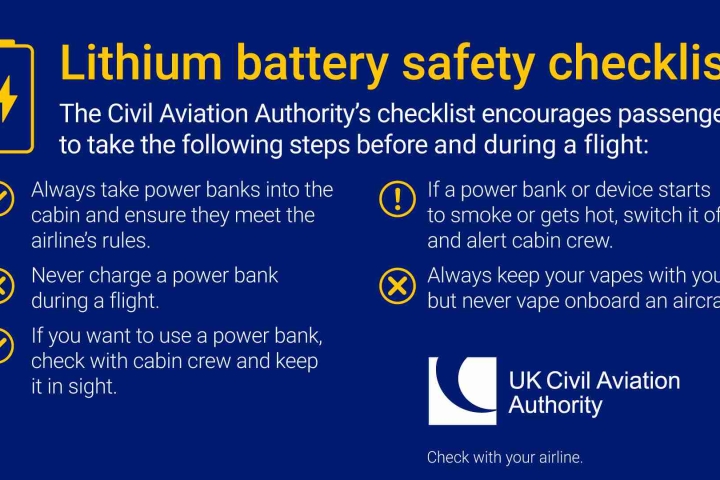
The Civil Aviation Authority’s checklist encourages passengers to take the following steps before and during a flight:
- Always take power banks in the cabin and check with your airline that they meet its size and quantity limits for carriage.
- Do not charge your power bank on any flight.
- If you want to use a power bank on a flight, first check that your airline allows it and keep it easily accessible.
- If a power bank, vape, phone or tablet starts to get hot then switch it off and stop charging and alert the cabin crew immediately.
- If a power bank or device starts to smoke, alert the cabin crew immediately. They are trained to deal with the issue safely.
- Always carry vapes inside the cabin with you but never vape onboard an aircraft.
Glenn Bradley, Head of Flight Operations at the UK Civil Aviation Authority, said:
“Firstly, it’s great that more passengers know to take power banks and lithium batteries with them in the aircraft cabin where any issue can be dealt with. But the chance of devices overheating and catching fire still remains. That is why we are now also offering our check list to people on how to deal with incidents.
“Knowing where to pack these devices is important, but passengers should also know what to do if one starts overheating during a flight. Spotting the warning signs and alerting cabin crew quickly can make an important difference.
“Pack right for a safe flight. Pilots use check lists every flight to remind themselves of safety procedures. We’re now asking passengers to use their own version so they can play a vital role in safety.”
Samantha Jeffcott, Head of Security Compliance at London Stansted, said:
“We’ve welcomed record-breaking numbers of passengers this year and expect that upward trend to continue over the half-term holidays, as many families take to the skies for a well-earned break.
“That makes it more important than ever that passengers know how to travel safely with lithium battery-powered devices.
“The last thing anyone wants is for their holiday to start with delays at check-in or security, so it’s important to come prepared and know where these devices should be packed.
“A quick check before you zip up your suitcase can make all the difference. By following the guidance before they fly, passengers can help keep their journeys smooth, safe and stress-free.”
The UK Civil Aviation Authority is continuing to work with airports and airlines across the UK to improve awareness of lithium battery safety and help reduce the risk of onboard incidents.
For more information on travelling safely with lithium batteries and to view the full guidance, visit www.caa.co.uk/packright.