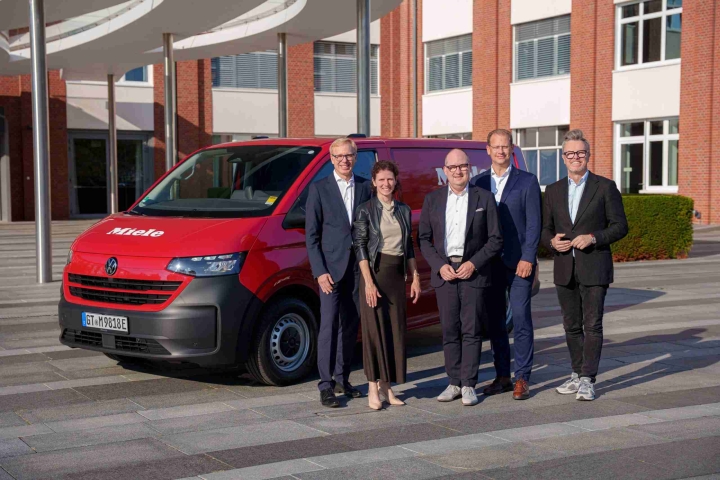
Miele is pressing ahead with the electrification of its service fleet: in Professional Customer Service, almost the entire team of 420 colleagues will in future be on the road in battery-electric Transporter vans from Volkswagen Commercial Vehicles. Domestic Customer Service is also steadily increasing its share of electric vehicles. With a total of 840 new service vans to serve domestic and commercial customers across Europe, the company is taking another significant step towards lower-emission mobility.
At 440 vans, just over half of the vehicles will be deployed in Germany. The Europe-wide tender covered 2026 and 2027 – and the choice fell on the Transporter from Volkswagen Commercial Vehicles (VWCV), combined with professional vehicle racking from Sortimo.
“The electrification of our vehicle fleet is a key component of our company’s sustainability strategy,” emphasises Rebecca Steinhage, Executive Director Human Resources & Corporate Affairs at Miele. Since the service vehicles are on the road every day, they offer an effective means of reducing direct CO₂ emissions and gradually replacing fossil fuels with electricity.
The transition has been particularly far-reaching in Professional Customer Service: almost all of the 420 staff members will be equipped with battery-electric vans. This gives Miele an electric share of almost 100 per cent in this unit.
In Domestic Customer Service, the share of battery-electric vehicles currently stands at around 30 per cent and is set to rise further as the fleet is gradually replaced.
“The continuation of this successful partnership is a strong vote of confidence in Volkswagen Commercial Vehicles and the e-Transporter,” says Lars Krause, Member of the Board of Management for Sales, Marketing and Aftersales at VWCV. “Together, we are demonstrating that electric mobility is a convincing and cost-effective solution for day-to-day fleet operations, and we are making a tangible contribution to reducing CO₂ emissions.”
Electrification as a means of reducing CO₂ emissions
By modernising its service fleet, Miele is supporting its goal of further reducing CO₂ emissions. In addition to the powertrain, the vehicle’s weight, equipment and operating profile also influence energy consumption. Sortimo’s vehicle racking helps by providing a lightweight yet secure solution for tools and spare parts. Less weight means lower energy consumption – an important factor in efficiency, particularly for battery-electric vehicles.
“We have two key objectives in mind with the electrification of our service fleet: we are reducing the direct CO₂ emissions of our customer service operations while at the same time creating modern, efficient mobile workstations for our technicians,” says Rebecca Steinhage. “Our experience from day-to-day service operations shows us that electric mobility works very well when the vehicle, charging infrastructure and operating profile are consistently aligned.”
Drawing on experience from customer service
Miele already uses a range of vehicles with alternative powertrains in its customer service fleet, including the ID. Buzz from VWCV. Findings regarding range, charging times, energy consumption and suitability for everyday use, as well as feedback from the technicians, have been fed directly into the requirements for the new generation of vehicles.
Travelling more sustainably, working more comfortably
The new vehicles also improve the service team’s working day. The electric drive makes stop-and-go traffic particularly easy to handle. Thanks to pre-conditioning, the cabin can be heated while the vehicle is still connected to the charging infrastructure.
Modern assistance and safety features, as well as the ergonomic Sortimo racking, round off the concept. In this way, Miele combines the demands of a high-performing customer service with the goal of increasingly electric mobility.