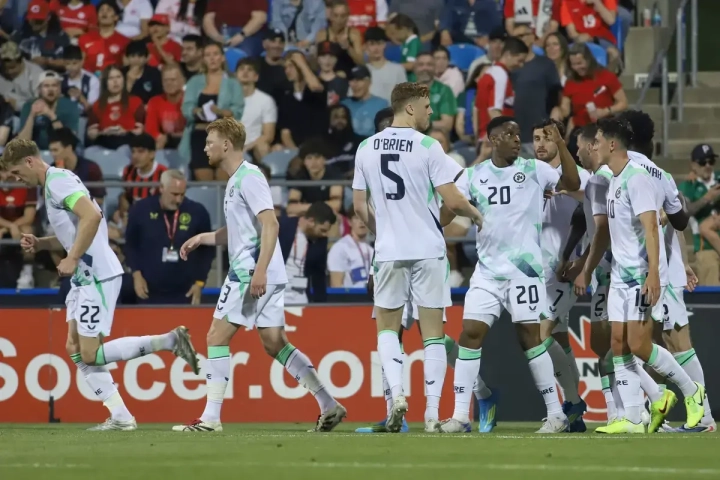
The Football Association of Ireland (FAI) has confirmed that the Republic of Ireland’s upcoming UEFA Nations League home fixture against Israel will be moved from Dublin’s Aviva Stadium to a neutral, overseas venue and played behind closed doors.
The match, originally scheduled for October 4, 2026, has been the subject of intense political and public scrutiny due to the ongoing conflict in the Middle East. With UEFA officially approving the FAI’s request for relocation, the move attempts to navigate a complex intersection of international sporting obligations, domestic security concerns, and severe public pressure.
Israel’s “home” match against the Republic of Ireland, scheduled a week earlier on September 27, was already slated to take place at a neutral location.
The Decision to Relocate
For weeks, the FAI board held meetings to evaluate the feasibility of hosting the Israeli national team in Dublin. Ultimately, consulting with An Garda Síochána (the Irish police) and various stakeholders led to the conclusion that the match could not safely or practically go ahead on home soil.
“Following consultation with various stakeholders, the Association is of the view that operational challenges could impact on the delivery of the game on home soil, so the fixture will be played away from the Aviva Stadium,” the FAI said in its official statement.
The FAI thanked the Gardai for their ongoing advice and noted that the decision was supported by UEFA as the most appropriate course of action.
Mounting Pressure and Protests
The backdrop to this fixture has been fraught with tension. Public pressure for a complete boycott of the matches against Israel has grown significantly in Ireland in response to the devastating conflict in Gaza.
- The “Stop The Game” Campaign: Spearheaded by the pressure group Irish Sport For Palestine, campaigners have demanded a boycott, citing what they describe as clear breaches of UEFA and Fifa statutes by Israel.
- On-Pitch Disruptions: The depth of public feeling was on full display in May during the Republic of Ireland’s 1-0 friendly victory over Qatar. The match at the Aviva Stadium was temporarily disrupted when protesters threw tennis balls adorned with Palestinian flags onto the pitch.
- Political Demonstrations: Further protests were recently held outside the Dáil (the Irish parliament) by the Ireland Palestine Solidarity Campaign, urging the FAI and the government to intervene.
Why Not a Full Boycott?
Despite the intense domestic pressure, the FAI has maintained that entirely boycotting the fixtures is not a viable option, warning that refusing to play would have a “profound impact on the whole of Irish football.”
Under UEFA’s strict competition rules, withdrawing from the matches would trigger immediate and severe sporting sanctions, including:
- Points Deduction: The immediate forfeiture of six points, likely leading to relegation to League C in the Nations League.
- Ranking Impacts: Severe damage to the team’s UEFA and Fifa rankings, which would drastically harm their qualification chances for Euro 2028.
- Advantage to Israel: The converse impact would apply to Israel, inadvertently boosting their chances of Nations League promotion and Euro 2028 qualification.
- Financial and Grassroots Damage: Beyond the senior team, financial penalties would reduce the FAI’s capacity to fund grassroots clubs, educational programs, and underage international teams.
Interestingly, the FAI’s decision to fulfil its fixtures while relocating the home game received backing from the Palestinian Football Association (PFA). The FAI shared a statement from the PFA, which expressed appreciation for Ireland’s “principled positions” in support of Palestinian rights, while affirming respect for the FAI’s decision to fulfil its sporting obligations.
The Players’ Dilemma
The geopolitical storm surrounding the match has inevitably placed the Republic of Ireland squad in an uncomfortable position. Senior players have openly expressed frustration that the burden of this issue has fallen on their shoulders.
Veteran defender Seamus Coleman was highly critical of the situation, noting that the decision of whether to play should never have been left to the athletes.
“I am a dad, I am a husband, I’ve got a heart, I know the difference between right and wrong… It is awful, it is extremely sad and it’s a very difficult position for the players to be in,” Coleman stated. “It should not have landed on 22, 23, 24-year-old lads that are here to play for their country… It should have been dealt with above us.”
Meanwhile, team captain Nathan Collins assured that the squad would respect the individual choices of any players who felt morally compelled to sit out the fixtures. “If individuals wanted to take a stand, we are not going to stand against them, we are not going to hold them back,” Collins said.
What Comes Next?
While a neutral venue resolves the immediate security and operational fears of a Dublin-hosted match, it does not quell the wider debate. Last year, the FAI overwhelmingly approved a motion calling on UEFA to ban Israel from European club and international competitions, a stance the association says it still reflects today.
As September and October approach, the Republic of Ireland will prepare to face Israel behind closed doors in a yet-to-be-named overseas venue, in what has become one of the most politically charged fixtures in the nation’s recent sporting history.