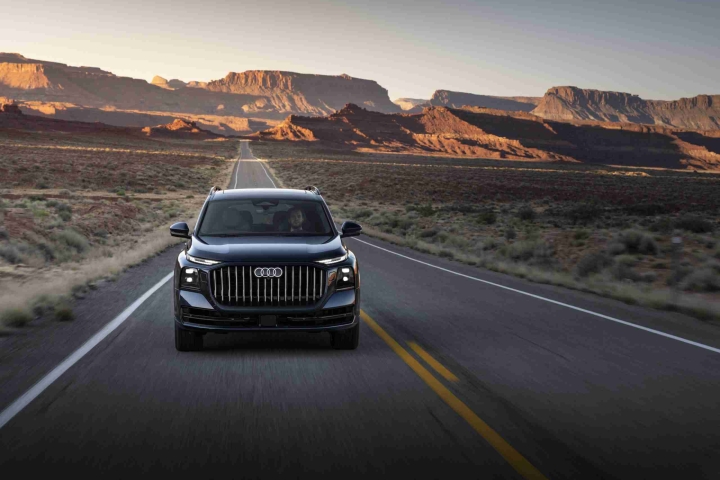
- Audi CEO Gernot Döllner: “The Audi Q9 is the new flagship of the Audi portfolio. With our first large full-size SUV, we are elevating our brand’s premium positioning.”
- The new full-size SUV impresses with an unrivalled sense of space; premium materials, individual electric seats in the second row, and automatic doors underline the business-class atmosphere
- The new flagship model represents technical excellence with comprehensive driver assistance, Audi’s largest panoramic sunroof, and curved digital OLED rear lights – a world first
With its largest SUV to date, Audi is assigning the number 9 for the first time and strategically expanding the top end of its model portfolio. The new Audi Q9 combines spaciousness, precise dynamics, and technological innovations in a single vehicle. Highlights include third-generation curved digital OLED rear lights, individual electric seats in the second row, power doors and the largest panoramic sunroof* ever fitted to an Audi. Sophisticated suspension and quattro all-wheel drive, paired with highly efficient powertrains, guarantee remarkable performance and composure on almost every surface. The SUV will be available to order from the end of August, with first UK deliveries due at the end of the year.
“In the future, ‘Vorsprung durch Technik’ will increasingly be defined by the in-car experience – because cars are much more than just a means of transportation. For many of our customers, they are becoming mobile living spaces,” says Audi CEO Gernot Döllner. “That is exactly what the Audi Q9 represents as the new flagship of our portfolio. Premium materials, individual electric seats in the second row, and automatic doors underscore our commitment to quality in the interior. When combined with the latest driver assist systems and a holistic user experience, it becomes clear where we are taking the Audi brand.”
The interior of the new Q9, featuring premium materials and standout features, underscores Audi’s commitment to quality. Two interior variants with distinct equipment packages offer customers numerous options for personalisation. The new Q9 seats seven passengers as standard. Large families will appreciate that all three seats in the second-row feature mounting points for child seats. The Q9 is optionally available with six seats – delivering extra space and a business-class atmosphere. All six seats are partially power-adjustable with standard heating function.

Q9 on-location
The two electrically adjustable individual seats in the second row are a particular highlight. In the third row, each seatback folds down individually at the push of a button. In the first row, the sports seat plus also adds ventilation and massage functions. For the first time, automatic doors offer increased comfort when entering and exiting the vehicle. Extensive surround sensors protect against collisions: an obstacle detection system stops the door if it cannot be opened fully. An electric soft-close mechanism ensures the doors shut gently. The power doors can be conveniently opened and closed from multiple control points and remotely via the myAudi app.
Another highlight of the Q9 interior is the largest-ever panoramic sunroof* in an Audi, fitted as standard. It features a glass surface of more than 1.5 square metres that can be opened wide or tilted. Optional features include switchable transparency, and, for the first time, illumination of the glass roof whose colour adapts to the personalised ambient lighting.
The Audi Q9 is unapologetically high status. Measuring 5.31m long, 2.21m wide, and 1.81m tall, with a wheelbase of 3.14m, it is the largest Audi of all time. Its upright front gives the full-size SUV an assertive stance and unmistakable character. Alloy wheels of up to 23 inches amplify the presence of the new Q9, while design elements such as the roof rails, bold rear overhang, and upright cabin emphasise the utility and generous proportions of the SUV.
Advanced lighting technology adds to the Q9’s powerful presence – including a world premiere. The third-generation digital OLED rear lights set new standards for form, function, and safety. The outer digital OLED panels, a world first, are curved in three dimensions thanks to ultra-thin glass. This not only opens new design possibilities – allowing the panels to flow with the vehicle’s silhouette – but also increases visibility, as the light can be seen from a wider angle. A second innovation in lighting technology similarly boosts road safety: the advanced turn signals. At night, this feature projects a stylized turn signal onto the ground in sync with the dynamic signals at the front and rear, ensuring high visibility for other road users. Digital Matrix LED headlights with a micro-LED module provide excellent range, precise illumination, and high contrast. Their expanded light guidance functions ensure added safety on the road.
With its assistance systems, the Audi Q9 purposefully meets the high expectations of premium customers. At launch, the Q9 will be with a 3.0-litre V6 diesel engine delivering 299 PS and 630 Nm of torque. The engine also features MHEV plus technology with an electric-powered compressor for direct throttle response. The MHEV plus technology, including a next-generation powertrain generator, supports the drivetrain with up to 18 kW (24 PS) of extra power and up to 370 Nm of additional torque. The 3.0-litre V6 diesel engine thus offers powerful starts and highly efficient driving. The Q9 is equipped with a fast-shifting eight-speed tiptronic and quattro permanent all-wheel drive as standard.
You can find detailed information about the Audi Q9 below.
*The illuminated panoramic sunroof with switchable transparency is not available for the start of presales. An exact launch date will be communicated later in the year.
Interior with thoughtful seating, automatic doors, and premium space
The interior design continues the geometric integration of the dashboard and doors, underscoring a commitment to precision. Clean lines and clearly defined surfaces create order and focus. Details like the air vents deliberately recede into the background, but their electrically adjustable, dynamic control via the user interface makes them a practical highlight.
The generous interior of the Audi Q9 inspires a sense of elegance and freedom. As standard, the model series has three rows of seats for a total of seven occupants. All seats are electrically adjustable. An optional layout with six power-adjustable seats prioritizes comfort, especially with the individual electric seats in the middle row. Audi is offering power doors for the first time – they provide increased comfort when entering and exiting the vehicle. The wide opening angle of up to 90 degrees allows easy access. Obstacle detection automatically stops the door if a person or object is detected in its path. The Q9 comes equipped with sports seats plus in the front, which offer heating, ventilation, and massage functions and can be adjusted via seat-mounted controls.
The door armrests and the centre armrests in the front and rear are heated with surface heating plus. This feature is activated using the seat heating controls, with corresponding intensity levels.
In the seven-seat layout, the second row is designed with a 35/30/35 split, and all three seats are equipped with Isofix-compliant mounting points for child seats. Thanks to the long wheelbase of 3.14m, even the third row provides ample space for adults. The second-row seats are power-adjustable fore and aft, while the seatbacks fold in a 65/35 split. In the 65-percent section, a 30-percent centre portion can also be folded down manually, creating a 35/30/35 split.
For easier access to the third row of seats, the outer seat in the second-row slides forward electrically and tilts forward without folding down. Thanks to this function, child seats fitted there do not need to be removed. Comfort entry can be activated via the MMI or a button in the entry area of the rear door. In the seven-seat configuration of the Q9, all second- and third-row seats can be folded sequentially. The front-row seatbacks are additionally equipped with a dedicated map pocket. The various seat functions – such as folding down the third and second rows – can also be controlled from the boot.

Interieur
Panoramic sunroof* offers more light and space
Beyond the seating layout, the standard panoramic sunroof plays a key role in the exceptional sense of space inside the Audi Q9. It is the largest panoramic sunroof ever installed in an Audi and can be opened or tilted for a pleasant breeze. Thanks to its stepless mechanism, the sunroof’s large opening can be individually adjusted for the desired level of ventilation. Switchable transparency in the laminated safety glass is available as an option. With a total of nine individually controllable segments, this makes it easy to switch between a light-flooded interior and effective glare protection.
When the Q9 is parked, the roof automatically turns opaque to prevent people looking in from outside. When the car is started again, the most recent setting is restored. The standard coated laminated glass reflects infrared light and blocks more than 99.5 percent of UV radiation. A conventional blind is no longer necessary. An integrated wind deflector reduces wind noise when the roof is open. The panoramic sunroof is operated via a button in the roof module or the MMI. In the top trim level, the panoramic sunroof also features illumination that displays one of 30 different colours to match the selected ambient lighting when the roof is closed. A total of 84 LEDs in the panoramic sunroof attractively illuminate the vehicle interior.
*The illuminated panoramic sunroof with switchable transparency is not available for the start of presales. An exact launch date will be communicated later in the year.
Impressive interior lighting concept
Ambient lighting illuminates all doors as standard. The standard contour lighting in the dashboard and doors accentuates the width of the interior. Indirect lighting beneath the Audi MMI panoramic display and in the centre console creates a subtle floating effect. A central element is the dynamic interaction light (IAL) in the ambient light package plus: a continuous LED light strip spans the full width of the interior and supports interaction between occupants and the vehicle. In addition to a welcome function and a lock/unlock indicator, the IAL also visualizes the dynamic turn signal, for example. A distinctive highlight is the light signature in the headrest of the sports seat plus, which serves as a unique identifying feature visible even from the outside. In addition, integrated sound design with noise-cancelling technology in the headrest provides for a quiet, comfortable atmosphere.
Sound system transcends interior boundaries
Audi optimally combines the interaction light with the updated Bang & Olufsen premium sound system with 4D sound. The IAL uses its “experiences” feature to sync with the rhythm of the music, creating an immersive experience by matching the colour scheme to the track’s cover art. The system builds on the previous 3D sound system with headrest speakers and adds innovative seat actuators in the front seats. The goal is an immersive, personalised sound experience that makes music not only something you hear, but something you can physically feel. The Q9 cabin is filled with sound from a total of 22 speakers, including tweeters and mid-range speakers with 3D sound, subwoofers, an optimised centre speaker, and four headrest speakers – two each for the driver and front passenger. The total system output is 1,360 watts. The headrest speakers enable personal phone calls, navigation prompts, and surround sound without acoustic distractions for other passengers.
Compared with conventional surround sound, the 4D system delivers an authentic concert-hall atmosphere. The integration of Fraunhofer Symphoria® enables adaptive sound distribution. The seat actuators generate finely tuned vibrations that sync with the music and intensify the bass sensation – the experience is like being at a live concert. Users can flexibly adjust the degree of immersion via individually configurable sliders or preset sound profiles or turn it off entirely.

Interieur
Comprehensive equipment
In the new Q9, Audi is expanding the range of interior options. The expansive surfaces are ideal for showcasing materials to their full effect. High-quality fabric and wood trim, new decorative accents, and coordinated colours create an atmosphere of premium comfort. The interior combines exclusive quality, evident down to the finest stitch, with pioneering materials. Attention has been paid to material selection: premium upholstery from Dinamica microfiber, leather and leatherette blends, and fine Nappa leather contribute to the refined character of the Q9. The cabin is further enhanced by decorative elements in lime structure natural, grey brown; or carbon fibre weave with basalt grey accents. Colour-coordinated trim elements throughout the cabin, along with the reduced use of glossy surfaces in favour of matte and textured materials, ensure an elegant aesthetic and minimize fingerprints. The steering wheel also adds a fresh touch with a standard upgrade of the airbag cover in leather and with colour matched contrast stitching.
Room for everything with generous storage in the Q9
The largest Audi SUV to date offers a wealth of storage solutions. Above all, the redesigned and versatile centre console in the Q9 offers flexibility: it features innovative wireless charging solutions for cell phones, such as a dual charger for two smartphones compliant with the Qi2.2 standard. This enables fast and efficient charging. Alternatively, the front seat backrest covers offer wired, USB-C fast-charging with an output of up to 100 watts in the rear. The cup holders in the second row can hold a large drink container and, for example, a bottle. The new Audi Q9 also offers plenty of space and thoughtful organisational options in the luggage compartment: a new standard aluminium rail system integrated into the sides of the trunk allows users to secure cargo in three dimensions with sliding hooks and adjustable anchors. This setup makes it easy to stow smaller items and frees up space on the boot floor for larger items. A roof rack for the roof rails is also included. When the third row of seats is in use, the luggage compartment cover can be stowed under the cargo floor to save space.
The exterior: reinterpreting premium
The new Audi Q9 makes a bold statement with its commanding exterior design. The front end integrates the brand’s signature Singleframe and the headlights into a seamless black mask – giving the vehicle its confident, authoritative look. The grille extends deep into the lower fascia, lending the design a stronger vertical presence and reinforcing the Q9’s position at the top of the lineup. The bumpers, by contrast, are deliberately understated, forming clean, cohesive surfaces. The vertically oriented front end gives Audi’s largest SUV a sense of stature and prestige. An illuminated Singleframe with LED technology is available for an even more striking appearance at night. The Q9 has a straight and level beltline, accentuating the car’s elongated silhouette. This is complemented by Audi’s signature pronounced shoulder line, which reinforces the Q9’s commanding presence.
The long wheelbase, larger rear doors, and extended rear overhang are especially noticeable toward the back of the cabin, contributing to the spacious feel inside the Q9.
At the rear, the license plate is positioned in the bumper. This placement emphasises a sense of calm and refinement, creating a clean rear surface. In a world-first application of the technology in a production vehicle, curved digital OLED rear lights create a distinctive signature after dark, enhancing visibility and safety on the road while reinforcing the car’s clean aesthetic. A continuous LED light strip featuring illuminated Audi rings connects the two rear lights.
The generous interior space – with third-row seating and a large boot – is most evident in the upright rear end and its extended overhang. A standout feature at the side of the vehicle is a ground projection that welcomes passengers as they approach with an unrolling carpet of light: the graphic projected beside the doors echoes the rhombus motif established by Audi Sport.
World-first digital OLED rear lights 3.0 with curved digital OLED panels
In top spec Q9 models, Audi has equipped the rear lights with third-generation digital OLED panels, setting new standards in lighting technology. The world’s first curved digital OLED panels integrate even more seamlessly into the contours of the body – combining visibility, safety, and design like never before.
The curvature of the digital OLED panel is key to the enhanced safety. The glass substrate is just 0.1mm thick. Thanks to ultra-thin glass technology, the panel follows the contours of the body precisely. This significantly improves visibility – especially from the sides of the vehicle – and enhances road safety. The curved digital OLED rear light delivers strong contrast and uniform light distribution. The outer curved OLED panel is the largest panel ever fitted in an Audi, comprising 99 segments. The centre panel has 84 segments, the inner panel 73. A total of 512 segments are distributed across six large digital OLED panels – making the vehicle appear significantly wider at night.
For the first time, the rear lights no longer display their digital light signatures only as static or fully active patterns: new, partially active light signatures in the digital OLED panels create a distinctive lighting design at night.
Advanced turn signals for better visibility when turning
A second lighting highlight in top spec Q9 models are the advanced turn signals, which are available in combination with the digital OLED rear lights and the digital Matrix LED headlights. When turning or changing lanes at night, they project a stylized turn signal onto the ground – in sync with the dynamic turn signals at the front and rear. This is more visible to other road users and significantly increases safety.
Communication light enhances safety
The communication light in top spec Q9s alerts other road users to accidents and breakdowns ahead. It displays a distinctive rear light signature in the digital OLED rear lights with an integrated warning symbol in the form of a hazard triangle. The model also features a connected exit warning: using a dedicated light signature, it alerts cyclists or other vehicles approaching the stationary vehicle from behind to potential collisions when occupants are opening their doors.
Projection light in the doors welcomes passengers
With an LED module in the door sills, the new projection light projects a solid white rhombus onto the ground beneath the driver’s and front passenger’s doors and a dashed rhombus beneath the rear doors. The rhombus unfurls when the doors are opened, welcoming the passengers and lighting the path to the vehicle. In conjunction with the exit warning, the car projects the rhombus onto the ground next to the door when cyclists or cars approach while a passenger is getting out of the Q9.
Intelligently connected lighting functions and driver assist systems
For optimum forward visibility, the Q9 features digital Matrix LED headlights with a new micro LED module. This combination delivers outstanding illumination and high-resolution light distribution for the high beams.
Another feature is the projected lane change assist warning, triggered when the driver of the Q9 initiates a lane change while another vehicle is in the blind spot. The orientation light also displays a lane departure warning on highways and non-urban roads – similar to the familiar alert in the instrument cluster – as soon as the driver unintentionally crosses a lane marking. When roads outside built-up areas are potentially icy, the enhanced traffic information system briefly projects an ice crystal symbol onto the road surface as a warning.
The deeper integration of driver assistance into the headlights is also evident in other driving situations. For example, the digital Matrix LED headlights with micro-LED modules improve awareness in construction zones. They automatically adjust the light guidance by switching off the lane light in favour of the orientation light, making it easier to stay in lane. The digital Matrix LED headlights also feature a marking light that helps identify pedestrians. In the dark, it highlights people near the roadway by illuminating them directly.
Driver assistance helps in critical driving situations
The Audi Q9 features a comprehensive suite of active and passive safety technologies. These include:
- Automatic emergency brake system: forward and rearward collision avoidance with pedestrian and cyclist detection
- Blind spot monitoring: visual alerts when vehicles are in adjacent lanes
- Rear cross-traffic alert: warns of approaching vehicles when backing out of parking spaces
- 360-degree camera system: surround-view cameras with multiple viewing angles for parking and manoeuvring
- Park assist: automated parallel and perpendicular parking with control of steering, acceleration, and braking
- Trailer manoeuvring assist: takes over steering when reversing with a trailer attached; the driver controls the direction via the Audi MMI display
- Trailer stability control: detects trailer sway and stabilizes it by applying targeted braking to individual wheels
- Integrated trailer brake control: factory-installed for seamless control of trailer brakes
Exit warning prevents collisions
Exit warning is a feature of the Audi Q9 that can enhance safety in city traffic involving various road users. Radar sensors in the rear bumper monitor the area around the stationary Q9 and detect approaching vehicles, cyclists, and pedestrians. If the system detects a potential collision, it prevents the doors from opening or stops a door that is already opening, displaying warnings via the communication and projection lights. This feature is also designed to protect passengers in the back seats – especially children – who are unable to use the rearview mirror.
Emergency assist brings the car to a controlled stop
The Q9 features a new emergency assist function for the first time: steering to the shoulder. Emergency assist detects when the driver is inactive within the system limits. They are prompted to take control of the vehicle through visual, audible, and haptic cues. If they still do not respond, the system takes control of the vehicle. This can be achieved by lane guidance and a gradual reduction in vehicle speed. The system can also initiate additional measures, such as activating the hazard warning lights and delivering seatbelt and brake alerts.
On the highway, emergency assist can steer the Q9 onto the unoccupied shoulder at speeds between 31 and 18 mph and bring it to a stop – provided the shoulder is adjacent to the vehicle’s lane.
This is indicated to the driver via a message in the Audi virtual cockpit and the turn signal. Next, the system initiates the move to the shoulder. If a move to the shoulder is not possible, the Q9 comes to a controlled stop in the current lane. After a few seconds of inactivity, an emergency call is triggered.
Another new feature is the lane departure warning with two different modes – reduced and normal. If the road is clear, the system will, in reduced mode, simply alert the driver to a deviation from the lane with a slight vibration in the steering wheel and a red line on the display. In this mode, corrective steering inputs are applied depending on traffic conditions. In normal mode, leaving the lane triggers automatic steering corrections, visual warnings, and steering wheel vibrations, regardless of the traffic situation.
Infotainment consistently designed around user needs
The enhanced infotainment in the new Q9 is clearer and more user-centric than ever. The MMI panoramic display – with a curved design and OLED technology – comprises the 11.9-inch Audi virtual cockpit and the 14.5-inch MMI touch display. The 12.3-inch passenger display with distraction-free dynamic privacy mode is included as standard. Distracting content such as videos cannot be viewed from the driver’s seat while driving. If the passenger display is not in use or if no passenger is detected, a background image can be displayed. The infotainment system uses Android Automotive OS as its operating system. Apps are available via the Audi Application Store for third-party apps, which is directly integrated into the MMI and does not require a smartphone. At the launch of the Q9, apps are available in categories such as music, video, gaming, navigation, parking and charging, productivity, weather, and news. The store is constantly being expanded, and the app portfolio is tailored to each market. In addition to improved and more intuitive touch controls, the display operating concept also reflects global trends in user interaction. Voice control has been significantly enhanced. The Audi assistant, Audi’s self-learning voice assistant, can be used to control numerous vehicle functions via natural language.
With ChatGPT integration, customers can look up information and interact with the car while driving. The Audi assistant automatically recognises whether to execute a vehicle function, search for a destination, or provide a weather forecast, for example. Only if the Audi system cannot answer a general question will it be forwarded to ChatGPT. From the driver’s perspective, this happens seamlessly, as all functions are integrated into the Audi assistant. An optional factory-integrated dashcam system records videos, providing documentation in the event of an incident.
Balanced and powerful engines
At launch, a 299 PS 3.0-litre V6 diesel engine will be available in the UK, which develops 630 Nm of torque. To enhance efficiency and acceleration, the engine use an MHEV plus system, comprising a powertrain generator refined for the Q9, a belt alternator starter, and a lithium iron phosphate battery. The powertrain generator provides up to 370 Nm of torque and 18 kW (24 PS) of power when starting off and overtaking.
It enables electric driving and assists the internal combustion engine, which reduces CO2 emissions and fuel consumption. An eight-speed tiptronic and permanent quattro all-wheel drive are always on board.
The V6 TDI also features an electric-powered compressor (EPC – 7.5 kW peak power, 3.5 kW continuous power), which complements the MHEV plus system, and two-stage turbocharging. When needed, the electric-powered compressor builds up absolute boost pressure of up to 3.6 bar in just 1.2 seconds, ensuring a dynamic response. By providing more torque even at low engine speeds, the use of the electric-powered compressor also reduces fuel consumption. The combination of the V6 diesel engine, the powertrain generator, and the electric-powered compressor delivers impressive thrust, which is particularly evident when pulling away from a standstill.
Comfortable and versatile suspension and brakes
The Q9 comes standard with adaptive air suspension. It combines continuously variable damping with adjustable ride height, handling everyday driving situations and a variety of terrain with equal confidence. The adaptive system automatically adjusts to speed, load, and driving conditions. Drivers can also manually adjust the ride height as needed via drive select. The total adjustment range between the lowest and highest lift mode is 90mm. From balanced mode, the car can be lowered by 62mm to comfort exit height.
Adaptive air suspension not only ensures comfort but, in combination with progressive and all wheel steering, also delivers a composed and confident driving experience. All wheel steering increases the vehicle’s manoeuvrability at low speeds, while at higher speeds it enhances steering precision and stability. The system can steer the rear wheels by up to 5 degrees. The all-wheel steering operates fully automatically. At low speeds – such as in parking lots or narrow city streets – the rear wheels turn in the opposite direction to the front wheels, reducing the turning circle. At highway speeds, the rear wheels turn in the same direction as the front wheels, improving stability when changing lanes. The system also ensures the vehicle tracks more smoothly through sweeping curves and responds more dynamically in tight corners.
The Q9 decelerates using an integrated brake control system and ventilated brake discs. The lightweight composite brake discs at the front measure 400mm. The rear brake discs have a diameter of 350mm. The six-piston fixed caliper comes standard in grey, with red available as an option. The brake pedal, accelerator pedal, and footrest are fitted with stainless steel pedal caps as standard.
From long-distance comfort to a sportier driving style, the drive select dynamic handling system offers a wide range of driving characteristics across seven different modes. The drive select assistant automatically selects the appropriate mode while driving – based on the road situation or driving style.
Availability of the Q9
The Q9 is manufactured in Bratislava. The SUV will be available to order at the end of August 2026 when full UK pricing and spec will be announced, with deliveries to commence by the end of the year.
Subject to change / final UK specification will be available when sales begin in August