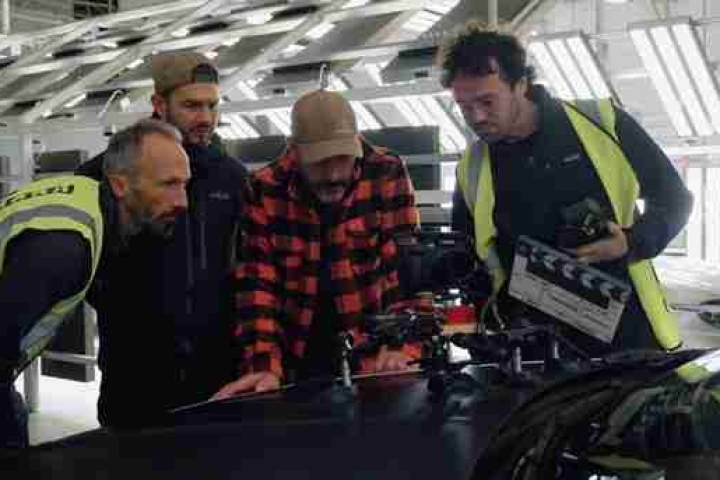
The production details behind Bentley’s most dynamic film ever – Supersports: FULL SEND, featuring Travis Pastrana – are revealed today, as the company clears the tyre smoke around the ambitious and ground-breaking project. A dedicated Behind-the-Scenes film released today shows how the film was shot over three days at Bentley, which included the first ever complete closure of the entire Bentley campus and a crew of over 100 people.
Supersports: FULL SEND was conceived in April last year, when the new Supersports provided the opportunity to create a totally new kind of film for Bentley. The first steps for the film – known internally as ‘Pymkhana’ (a gymkhana shot on Pyms Lane, the address of the factory) began with conversations with key internal departments at Bentley, which to the surprise of all those present, made it clear that the concept was indeed possible, with enough preparation. With the green light given by Bentley’s Board of Management, work started in Bentley’s R&D department to prepare a Supersports development vehicle to be as extreme as possible.
The electronic Limited Slip Differential was adjusted to provide early locking, and Electronic Stability Control was permanently disabled, and special software changes were written to allow both static and rolling burnouts. The key to success was the design and installation of a working hydraulic handbrake, integrated with the control system of the eight-speed double-clutch gearbox, which would allow the car to enter the tight corners of the factory road network sideways rather than relying on power-oversteer. The work to prepare the car was overseen by Bentley engineering manager Alistair Corner, who comments:
“The mission for our ‘Pymkhana’ car was to turn the already-capable Supersports up to 11 – to remove all the safety features that the production version must include, and to add functionality to allow the car to dance around the narrow roads of our factory. The team of engineers that developed the car was outstanding, learning on-the-fly and coming up with creative solutions to turn the car into a monster. Crucially, what that special car can now do is an extension of the inherent ability within Supersports – the Pymkhana car is a Supersports without limits, that demonstrates what our chassis and powertrain can do when taken to the extreme.”
Alongside the main star car – which has now joined Bentley’s Heritage Collection – a second, back-up car was also prepared, for the eventuality that the main car was damaged during filming. Both cars were wrapped in a bespoke, gymkhana-inspired design by graphic artist Deathspray, and completed with custom-painted 22” wheels. Beneath the star car, a pair of titanium skid blocks were mounted to generate the shower of sparks seen towards the culmination of the film.
Travis Pastrana agreed to join the project as the driver, and dates for filming were set as 26-28 September 2025. Before filming could commence, each ‘scene’ was planned in detail and choreographed, to ensure that risk to the car, driver and factory were all minimised. As a working factory, the number of possible risks were myriad, with extra care needed to protect gas mains, fibre optic cables, water pipes and even the electrical power supply to the entire factory – all of which were within inches of some of the dynamic locations. Scenes that involved other cars – like the car park chase sequence with the Pikes Peak Bentleys, or the Brooklands burnout sequence – required additional coordination and included two precision drivers that worked with Travis.
The filming itself involved a squad of over 100 people, split between the production crew and supporting teams from across Bentley. The main filming crew comprised around 25 people, including two main camera operators, two drone operators, two minicams technicians and a three-person crew that operated a purpose-built tracking car built out of a first-generation Bentayga W12, complete with a U-Crane arm.
Support teams included a 10-person set of location marshals who were responsible for guaranteeing that each location around the factory was completely closed-off for filming, 25 vehicle specialists (in two teams), a factory support team, medics, a fire crew, car wranglers, heritage car drivers and a health and safety unit.
Filming went almost without a hitch. Bentley’s Head of Product Communications, and Executive Producer for the project, Mike Sayer comments:
“The filming days were incredibly intense but ultimately the most fun we’ve ever had at the campus. We were fortunate with the weather, and the star car, the supporting cast of vehicles and all the teams involved performed to an exceptional standard. Despite the beyond-the-limit driving involved, and speeds exceeding 120 mph, the only damage sustained to person or machine was one smashed wing mirror! I’m grateful to every single Bentley colleague who worked so hard to deliver this unique project for us.”
After three days of filming, and three months of editing – both led by exceptional director Jon Richards – the finished film was released in January and contains 12 ‘Easter Eggs’; cars and details that only the eagle-eyed will spot. The full list of these can be found after the Notes to Editors section at the end of this press release.