An Epic Encounter in the Midwest
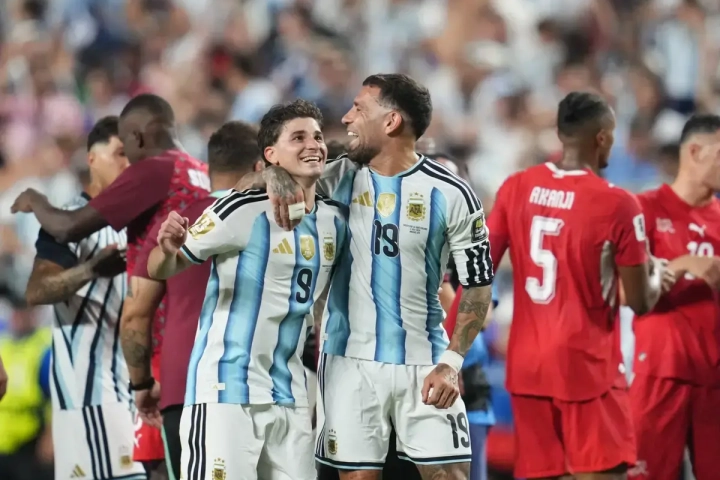
The scorching Midwestern summer air provided an intense backdrop for this deeply captivating FIFA World Cup 2026 quarter-final. Kicking off exactly at 02:00 BST on Sunday, 12 July 2026, the pulsating clash at the Kansas City Stadium in Missouri eventually concluded with a dramatic 3-1 victory for Argentina over Switzerland following extra time. Lionel Scaloni’s world champions were dragged to the absolute limit by a phenomenally resilient Swiss side. Escaping the peril of a penalty shootout by the narrowest of margins, the South Americans ultimately relied on a breathtaking late goal from Julián Alvarez and a stoppage-time strike by Lautaro Martínez to secure their hard-fought passage to the final four.
Tactical Blueprints and Early Breakthrough
Entering the high-stakes contest, both managers deployed formations crafted to exploit specific tactical advantages. Argentina lined up in a dynamic 4-1-3-2 system. Emiliano Martínez started in goal, protected by a defensive quartet of Nahuel Molina, Cristian Romero, Lisandro Martínez, and Nicolás Tagliafico. Leandro Paredes anchored the midfield, offering a platform for Rodrigo De Paul, Enzo Fernández, and Alexis Mac Allister to supply service to Lionel Messi and Julián Alvarez.
Across the technical area, Murat Yakin opted for a structured 4-2-3-1 setup. Gregor Kobel operated between the posts, shielded by Nico Elvedi and Manuel Akanji. The disciplined midfield pivot of Denis Zakaria and Remo Freuler was tasked with containing Argentina’s central creativity, while Granit Xhaka, Fabian Rieder, and Dan Ndoye supported lone striker Breel Embolo.
From the first whistle, the overarching pattern emerged swiftly. Dictating territorial possession, the reigning champions methodically probed the opposition’s defensive lines. Their early endeavours were rewarded in the 10th minute. Winning a corner, Messi delivered a tantalising, precise cross into the penalty area. Escaping the attention of his marker, Mac Allister executed a towering header that powered past Kobel. The diminutive midfielder’s effort sparked wild celebrations among the travelling supporters, marking a flawless start for the tournament favourites.
A Shift in Momentum
Having secured an early advantage, the South American heavyweights surprisingly eased their intensity. Content to concede possession, they invited the European challengers to break down their defensive block. For an extended period, the match slowed to a deliberate crawl, characterised by fragmented midfield battles and cautious ball circulation.
Yakin’s men, however, absolutely refused to capitulate. Gradually establishing a foothold, they began exploiting the vast transitional spaces left by the advancing Argentine full-backs. The momentum tangibly shifted following the half-time interval. Xhaka and Ndoye forced crucial saves from Emiliano Martínez, signalling clear attacking intent and growing confidence.
Their persistence eventually yielded a spectacular equaliser in the 67th minute. Launching a rapid counter-attack down the left flank, Ndoye exchanged an intricate one-two with the overlapping Ricardo Rodríguez. The defender delivered a pinpoint pass back across the penalty area, allowing the winger to slot a composed finish from a tight angle. The leveller completely stunned the Argentine defence, rewarding the Swiss for their courageous and relentless approach.
The Turning Point: VAR and a Crucial Dismissal
Barely five minutes after restoring parity, the entire complexion of the quarter-final was dramatically altered by an unprecedented officiating sequence. In the 72nd minute, Embolo surged forward and appeared to be brought down by a lunging Paredes on the edge of the box. Portuguese referee Joao Pinheiro initially awarded a free-kick, booking the Argentine midfielder for the challenge.
However, the Video Assistant Referee (VAR) immediately intervened, creating a moment of high tension inside the stadium. Utilising the tournament’s new rules regarding mistaken identity and simulation, the officials advised Pinheiro to review the incident on the pitch-side monitor. The implementation of this rule has been a major talking point throughout the competition, and this instance highlighted its profound impact on high-stakes knockout matches. Comprehensive replays conclusively demonstrated that Embolo had dived to win the foul, leaving no doubt about the severity of the infraction. The referee subsequently rescinded the caution for Paredes and brandished a second yellow card to the Swiss striker, who had previously been booked in the 43rd minute.
An inconsolable Embolo was given his marching orders, reducing Switzerland to ten men and forcing Yakin into a drastic defensive reshuffle. Despite the numerical disadvantage, the European side showcased exceptional discipline. Argentina aggressively pressed for a winner during the closing stages of regular time. Lisandro Martínez flung himself at a loose ball, executing a desperate scissor-kick that lacked the required power, ensuring the contest drifted into an exhausting extra-time period.
Substitutions and Extra-Time Attrition
Recognising the urgent necessity for fresh attacking impetus, Scaloni turned to his substitutes’ bench. Having already introduced Nicolás González, Lautaro Martínez, and Gonzalo Montiel during the second half, the Argentine manager brought on Thiago Almada, Nicolás Otamendi, and José Manuel López as the physically draining extra time unfolded. Yakin responded with a flurry of defensive changes, introducing Silvan Widmer, Zeki Amdouni, Miro Muheim, Eray Cömert, Ardon Jashari, and Rubén Vargas to fortify the heavily congested penalty area.
Throughout the first fifteen minutes of extra time, the ten-man Swiss outfit absorbed an astonishing barrage of pressure. Content to sit deeply and frustrate their opponents, they valiantly attempted to force the dreaded lottery of a penalty shootout. The strategy appeared remarkably successful until the final ten minutes, when individual brilliance definitively shattered their profound resistance.
Alvarez’s Masterclass and Late Polish
In the 112th minute, the persistent deadlock was finally broken. Receiving the ball roughly twenty-five yards from goal, Alvarez assessed his options amidst a sea of red shirts. Exhibiting phenomenal technique and elite situational awareness, the forward unleashed a ferocious, curling strike that rifled directly into the top right corner. Kobel was left clutching at thin air as the astonishing effort restored the South American advantage, breaking Swiss hearts in the process.
Desperately throwing caution to the wind, Switzerland abandoned their defensive posture during the dying embers of the match. Exploiting the newly vacated spaces, Argentina ruthlessly delivered the final knockout blow. Deep into the 120th minute, a sweeping counter-attack spearheaded by Almada tore through the exhausted European ranks. Almada’s initial shot was blocked, but the rebound fell perfectly into the path of Lautaro Martínez. The prolific marksman calmly slotted the ball home, adding the final gloss to a gruelling 3-1 victory.
Statistical Reflection and Semi-Final Implications
When analysing the underlying statistical narrative, the victors undoubtedly dominated ball possession and shot creation, but the final scoreline arguably flattered them against an incredibly stubborn opponent. Mac Allister’s opening goal meant Argentina scored in their fifteenth successive World Cup match, while Messi etched his name into history by becoming the first player since 1966 to reach twenty passes for shots across three separate tournaments.
Julián Alvarez was universally praised by pundits and rightfully awarded the Player of the Match accolade for his match-winning screamer. The victory marks a significant achievement for Scaloni’s defending champions, who have successfully navigated yet another deeply dramatic knockout fixture to keep their title defence alive.
The hard-fought triumph guarantees Argentina a blockbuster semi-final clash against England, scheduled for Wednesday in Atlanta. Facing a European heavyweight that also required extra time to eliminate Norway, the upcoming encounter promises to be a spectacular tactical battle heavily laced with historical significance. Scaloni’s coaching staff must quickly address their midfield’s tendency to lose concentration during defensive transitions, an issue that nearly cost them their tournament against the Swiss. Moreover, they will need to ensure that key players recover physically from back-to-back gruelling encounters.
For Switzerland, the heartbreaking reality of the defeat leaves them reflecting on a campaign that promised immense potential. Taking the reigning champions to the absolute brink, their courageous performance will command global respect. Murat Yakin’s men displayed a level of tactical cohesion and physical robustness that many pre-tournament predictions had completely overlooked. They depart the world stage fully aware that a singular moment of indiscipline ultimately cost them a historic place among the final four, but they will undoubtedly return to Europe with their heads held high.