The soaring architecture of the Kansas City Stadium in Missouri served as the spectacularly chaotic backdrop for what will undeniably be remembered as one of the most astonishing group-stage conclusions in FIFA World Cup history.
Kicking off in the early hours of the British morning at exactly 03:00 BST on Sunday, 28 June 2026, Algeria and Austria played out a breathtaking, bizarre, and utterly unforgettable 3-3 draw.
Entering the decisive Group J encounter, the permutations were clear: a draw would likely be sufficient to send both proud nations through to the newly expanded knockout phases, while a defeat could spell tournament elimination. What transpired over the ensuing ninety-plus minutes was a roller coaster of attacking brilliance, a highly controversial period of tactical stagnation, and a final, frantic crescendo that literally saved Austria from the brink of World Cup elimination.
Tactical Blueprints and an Explosive First Half
Heading into the fixture, Austrian manager Ralf Rangnick deployed his highly favoured 4-2-3-1 formation, instructing his energetic midfield pivot of Xaver Schlager and Nicolas Seiwald to dictate the tempo and disrupt the North African playmakers. Across the tactical divide, the Algerian setup mirrored their European counterparts, heavily relying on the creative ingenuity of Houssem Aouar and the established pedigree of captain Riyad Mahrez to unlock a typically resolute Austrian defence.
The opening exchanges were fiercely contested, characterised by combative challenges that resulted in an early yellow card for veteran Austrian forward Marko Arnautović in the 11th minute. Despite the physical nature of the contest, the European side gradually asserted their territorial dominance. Their patience was duly rewarded in the 28th minute.Capitalising on a momentary lapse in Algerian concentration, central defender David Alaba showcased his exceptional passing range, launching a precise, searching long ball over the top of the defensive line. Arnautović brought the ball down with a sublime touch, outmuscled his marker, and coolly finished underneath advancing goalkeeper Oussama Benbot to break the deadlock.
However, the North Africans refused to capitulate and immediately intensified their attacking efforts. As the first half drew to a close, they managed to restore parity in truly spectacular fashion. In the 45th minute, a bizarre sequence saw the ball ricochet awkwardly off the corner flag, keeping the play alive. Mahrez reacted with trademark sharpness, gathering possession and feeding Rafik Belghali. The defender embarked on an astonishing solo run, slaloming past three Austrian challengers before fiercely smashing the ball into the roof of the net at the near post. The teams entered the dressing rooms locked at 1-1, perfectly setting the stage for a dramatic second period.
Second-Half Swings and a Controversial Lull
Recognising the need for fresh impetus, Rangnick made three sweeping substitutions at the interval, introducing Paul Wanner, Michael Gregoritsch, and Florian Grillitsch. The tactical alterations provided immediate dividends. Ten minutes into the second half, Konrad Laimer collected the ball on the right flank, cleverly manufacturing a pocket of space before delivering a perfectly weighted pass into the penalty area. Marcel Sabitzer met the delivery with a laser-guided, first-time strike from eighteen yards out, giving Benbot absolutely no chance and restoring Austria’s lead in the 55th minute.
Yet, much like the first half, the Austrian advantage proved remarkably fleeting. A mere five minutes later, Algeria completely sliced through the European lines. Aouar surged powerfully down the left wing, reaching the byline before cutting a precise cross back into the danger zone. Mahrez, demonstrating the elite positioning that has defined his illustrious career, swept the ball home from close range to make it 2-2. The 60th-minute equaliser marked a significant personal milestone for the winger, registering his first goal across four different World Cup tournament appearances.
Following the second-half hydration break, the pulsating rhythm of the match abruptly ground to a complete halt. With the scoreline poised at 2-2, an unspoken, highly controversial non-aggression pact seemingly descended upon the pitch. Both sets of players became acutely aware that preserving the draw would guarantee their progression to the Round of 32, simultaneously eliminating Iran from the competition. For approximately twenty-five minutes, the encounter devolved into an incredibly sterile exhibition match. Algeria retained possession inside their own half, casually passing the ball back and forth, while the Austrian forwards entirely abandoned their pressing duties, jogging half-heartedly to maintain their defensive shape. The cavernous stadium echoed with a chorus of deafening, frustrated whistles from the thoroughly disillusioned supporters who had paid to witness a competitive sporting contest.
Stoppage-Time Betrayal and the Ultimate Miracle
Just as the final whistle loomed and the stadium began to empty, the match was suddenly injected with a dose of pure, unadulterated mayhem. Deep into stoppage time, in the 94th minute, Algeria abruptly abandoned their passive strategy. A sudden, vertical pass caught the complacent Austrian defence completely off guard. Aouar once again found Mahrez, who expertly peeled away from his marker and fizzed a low, clinical finish into the bottom corner. The 3-2 goal sent shockwaves through the arena; Austria were instantaneously facing World Cup elimination, while the Iranian camp, watching nervously from afar, were momentarily sent into wild celebrations.
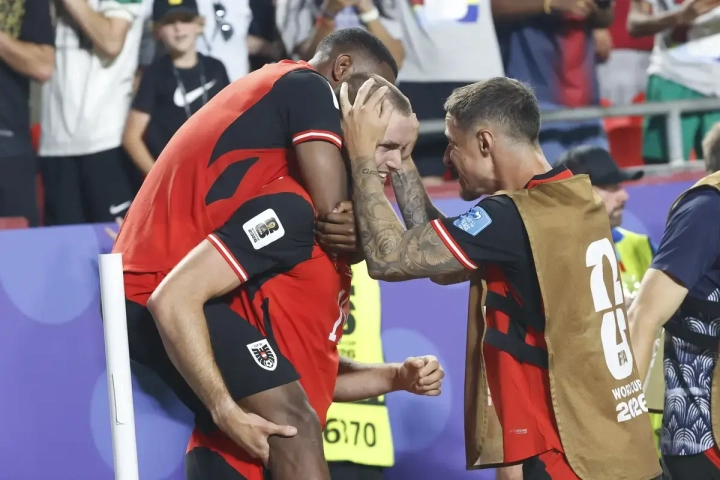
Staring down the barrel of an unthinkable exit with mere seconds remaining, Rangnick executed a final, desperate roll of the dice. He introduced towering 6-foot-7 striker Saša Kalajdžić, instructing his team to launch the ball directly into the penalty area. Miraculously, the gamble paid off in the 95th minute. With seemingly the final attack of the game, Sabitzer sprinted desperately down the left flank and lofted a hopeful cross toward the back post. Gregoritsch intelligently nodded the ball back across the face of the goal, landing perfectly in the path of Kalajdžić. The substitute made absolutely no mistake, heading home from close range to rescue his nation from the jaws of defeat. The incredible 3-3 equaliser sparked scenes of absolute, unrestrained delirium on the Austrian bench.
Tournament Implications and the Road Ahead
When the final whistle finally sounded just moments later, the contrasting emotions surrounding the fixture perfectly encapsulated the brutal, unforgiving nature of tournament football. The dramatic 3-3 draw ensured that both Austria and Algeria survived the chaos to progress to the knockout stages. Austria officially advanced as Group J runners-up behind Argentina, securing a highly anticipated clash against Spain at the Los Angeles Stadium on 2 July. Meanwhile, Algeria managed to progress as one of the best third-placed teams, setting up an intriguing encounter with Switzerland in Vancouver.
While the extended period of farcical possession retention will undoubtedly attract severe media scrutiny and debate in the coming days, the sheer theatre of the final moments will ensure this match is etched into World Cup folklore. For Austria and Algeria, the immediate focus must rapidly shift toward recovery and preparation for the rigorous challenges of knockout football. For Iran, however, Kalajdžić’s late header represents an incredibly cruel, heartbreaking end to their World Cup dreams, serving as a harsh reminder that at the highest level of the sport, fortunes can entirely change in the blink of an eye.
Official Match Facts
Goalscorers:
Austria: Marko Arnautović (28′), Marcel Sabitzer (55′), Saša Kalajdžić (90+5′)
Algeria: Rafik Belghali (45′), Riyad Mahrez (60′, 90+4′)
Discipline:
Austria: Marko Arnautović (Yellow Card, 11′)
Algeria: None