The following two things are supposed to be nominally – but not universally – true about business people.
They understand numbers, and they lean more right wing.
Both these are to be expected for various reasons.
Maths and business go hand in hand because to run a business properly, you need to be able to know and handle complex numerical process on some intuitive level. This skill set can let you know when, where, and how you are making and/or losing money and why. Computers and calculators can automate a great deal, but an intuitive underlying understanding will always have immense business value.
Free markets, property rights, and independence-focused individualism are often core tenants of right-wing thinking, and are also naturally attractive to business people. After all, who wants a literal or metaphorical government official leaning over your shoulder as you’re trying to make a sale?
So why then, have so many business-minded, mathematically-sound, right-wing thinking people dropped the ball so hard on the numbers around the cost of Net Zero?
The numbers in question being £7.6 Trillion. The supposed total cost of the UK reaching Net Zero carbon output by 2050.
This numbers seem to have come from NESO – the National Energy System Operator. These are the people who operate the UK’s entire power supply, and are therefore the ones who you would hope would know how much all this is going to cost.
Outlets like the Times, the Daily Mail, and the Daily Telegraph have all produced articles citing these figures and claiming NESO as a source. Even an industry insider publication, OilPrice.com, is linking directly to publications using this huge scary number of £7.6 Trillion as a headline.
You would think that business minded, mathematically competent, right-leaning thinkers would have objective basis for calculating these numbers close to hand, hence why they are so eagerly reporting them.
However, you’d think wrong.
The £7.6 trillion figure is a combination of upfront costs and ongoing costs (CapEx and OpEx to borrow business jargon) outlined by NESO in their report when reviewing how to make the transition to Net Zero.
Upfront costs meaning paying for things like new electric vehicles, new heat pumps, nd new energy infrastructure, and then ongoing costs of keeping solar panels clean, wind turbines lubricated, and new pylons and other infrastructure free of damaging corrosion.
You would think that by knowing Net Zero’s combined CapEx and OpEx costs, you’d have all the parts you’d need to know how much it costs. Except Net Zero isn’t happening in a vacuum.
Net Zero is a transition. A change. A shift from one model of energy generation into another.
The move to doing Net Zero means ending the status quo. The fossil fuel driven energy system we’ve been using in some form or other for the last 250 years.
As the entire existence of a website like OilPrice.com makes clear, that status quo has costs too.
Fuel costs money. Fuel processing power systems like gas powered turbines and jet engines cost money. Replacing power plants that are coming to the end of their natural lives with new fossil fuel power plants will also cost money.
NESO was also aware of this, and kind enough to put it in the same report that the £7.6 trillion figure came from.
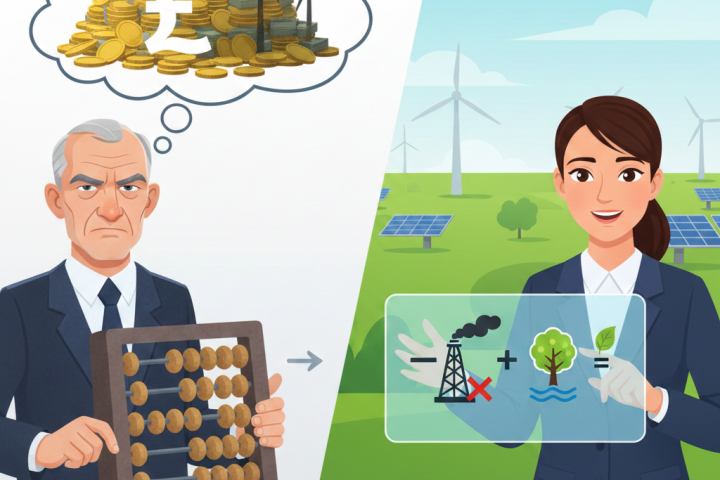
When you factor in all the costs that will go away as we reduce our spending on fossil fuels, the overall expense of Net Zero starts to go down. Not just down, it collapses.
What does it reach? £0.36 million.
Around twenty one time less than the big scary number that the right-wing, mathematically minded business people seemed to come up with. An easy mistake to make when you forget about the concept of subtraction.
The costs go down even further however, because the fossil fuel status quo doesn’t just have costs in terms that can be summarised by CapEx and OpEx. Climate change comes with its own cost bill.
Costs like more expensive food due to desertification shirking the total amount of arable land.
Costs like more heat in the climate system exaggerating natural disasters of all kinds, from floods to hurricanes and everything else.
If we want to understand the economic reality of Net Zero, we need to consider every part of the equation. A fully itemised bill. The kind that business people who read right wing outlets should also fully appreciate and understand.